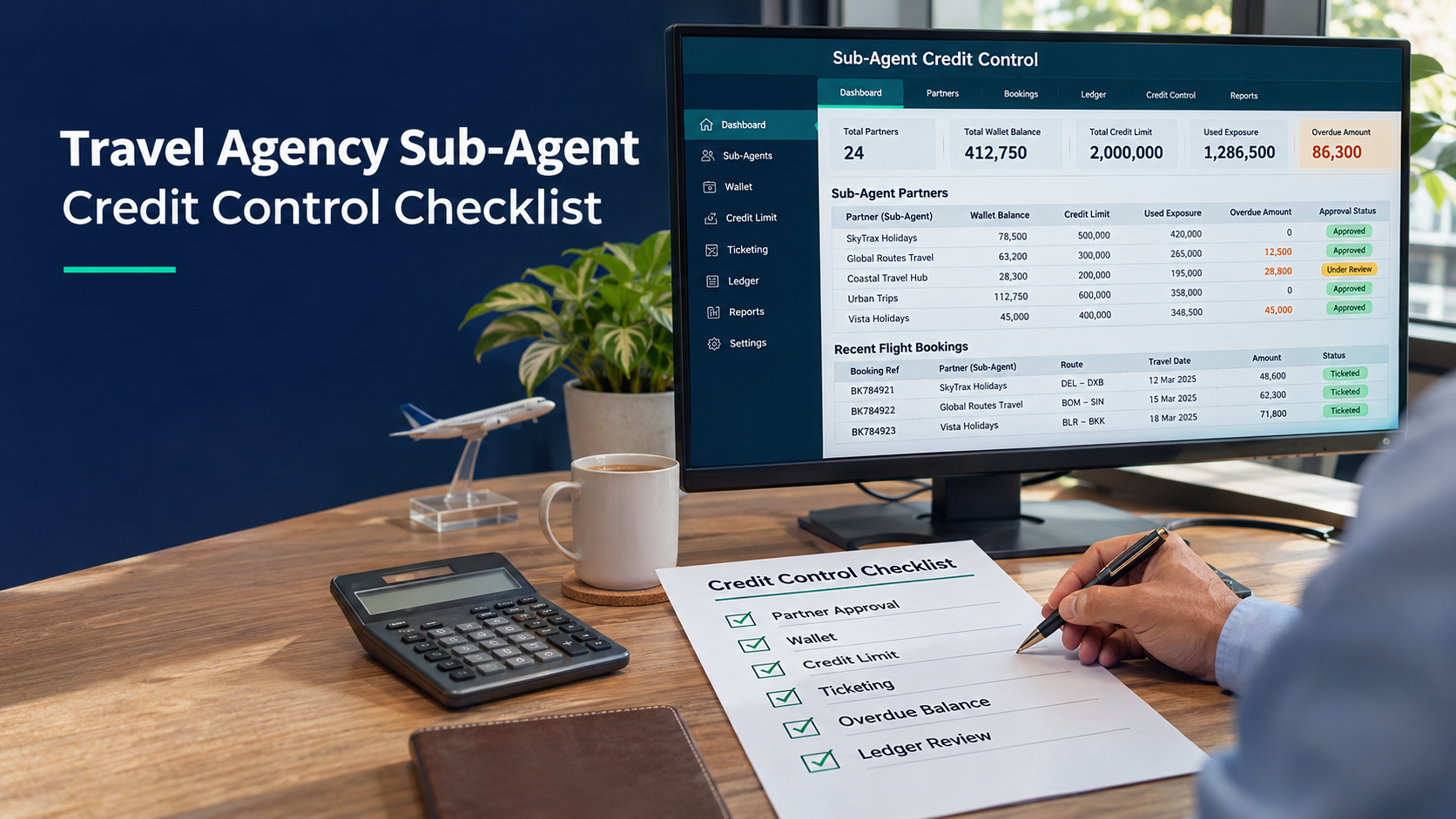
A sub-agent can create airline or hotel exposure in minutes. Finance may not discover the risk until the wallet is empty, a payment is overdue or the master agency must settle with a supplier.
The solution is not to stop offering credit to every partner. It is to make each credit decision visible, enforceable and connected to the booking workflow.
This travel agency sub-agent credit control checklist helps master agencies, consolidators and B2B travel networks review partner approval, wallets, deposits, credit limits, ticketing access, overdue balances, refunds and ledger controls. Use it during onboarding, vendor demonstrations, monthly account reviews and internal audits.
Score each item as Yes, No or Needs Action. A No on a critical control should be resolved before the sub-agent receives ticketing authority or additional credit.
Quick Travel Agency Sub-Agent Credit Control Checklist
| Control area | Question | Status |
|---|---|---|
| Partner approval | Has the sub-agent completed commercial and identity checks? | Yes / No / Needs Action |
| Funding model | Is the partner prepaid, secured credit or controlled unsecured credit? | Yes / No / Needs Action |
| Wallet | Does the system show cleared funds separately? | Yes / No / Needs Action |
| Credit limit | Is the approved maximum recorded and enforced? | Yes / No / Needs Action |
| Exposure | Are issued, pending and unsettled transactions included? | Yes / No / Needs Action |
| Ticketing | Is exposure checked before issue or confirmation? | Yes / No / Needs Action |
| Approvals | Are overrides approved by an authorized person? | Yes / No / Needs Action |
| Payment terms | Are due dates, ageing and overdue actions defined? | Yes / No / Needs Action |
| Ledger | Does every booking and adjustment update the agent account? | Yes / No / Needs Action |
| Refunds | Are expected supplier refunds kept separate from cleared cash? | Yes / No / Needs Action |
| Permissions | Can booking users change credit or approve deposits? | Yes / No / Needs Action |
| Alerts | Are low balance, overdue and limit-breach alerts active? | Yes / No / Needs Action |
| Reporting | Can finance see exposure by agent and currency? | Yes / No / Needs Action |
| Review | Does every credit facility have a next review date? | Yes / No / Needs Action |
1. Complete Partner Approval Before Credit Activation
The travel agency sub-agent credit control checklist should begin before the first booking. Credit must follow approval, not replace it.
Confirm that the agency has recorded:
- legal business name and registration details;
- trading address and verified contacts;
- owners or responsible directors where required;
- bank and payment details;
- expected products, markets and monthly volume;
- references or trading history where appropriate;
- signed commercial terms;
- internal account owner;
- approval decision and date.
A login is not a credit approval. Travilo's B2B travel partner onboarding checklist explains why registration, approval, finance activation and access should occur in the correct order.
2. Assign a Funding Model by Risk
Every partner needs a named funding model:
| Partner profile | Suggested starting model | Minimum control |
|---|---|---|
| New or unverified | Prepaid wallet | Booking cannot exceed cleared funds |
| Developing relationship | Deposit-backed or secured credit | Limit tied to verified security or deposit |
| Established and reliable | Controlled unsecured credit | Limit, due date and review cycle enforced |
| Overdue or high risk | Restricted or prepaid only | New exposure blocked without finance approval |
Do not grant identical terms to every agent. Volume does not prove collection reliability, and a long relationship does not remove the need for current review.
3. Separate Wallets, Deposits and Credit
This section of the travel agency sub-agent credit control checklist requires the system to show at least three values separately:
- Wallet balance: cleared funds available for transactions.
- Deposit: money received as prepayment or security, according to policy.
- Credit limit: unfunded exposure the master agency has approved.
Combining these numbers can make an account look safer than it is. A promised bank transfer is not cleared wallet value. A security deposit may not be available for daily spending. An airline refund that has not arrived is not cash.
Travilo's guide to travel agency credit control software explains how these records should remain connected without becoming one unclear balance.
4. Calculate Available Capacity in Real Time
Use a defined formula:
Available booking capacity = approved credit + spendable cleared wallet balance - unsettled exposure
The exact formula may change if deposits are security only or pending bookings reserve funds. Document the rule and apply it consistently.
The travel agency sub-agent credit control checklist should verify that exposure updates when a booking is held, confirmed, ticketed, voided, refunded, reissued or adjusted. An overnight report is not enough for a live ticketing operation.
5. Decide Which Event Enforces the Limit
A warning after ticket issuance is only a report. The travel agency sub-agent credit control checklist must identify the event that prevents exposure.
Choose where the limit is checked:
- booking creation;
- supplier confirmation;
- ticket issuance;
- post-ticket servicing that increases the amount due;
- every stage that creates additional exposure.
Many agencies allow search and quotation while blocking the action that creates a supplier obligation. The user should see the available amount, required top-up and next permitted action.
6. Restrict Ticketing and Financial Permissions
Searching, booking and issuing do not create the same risk. Separate permissions so that ordinary booking users cannot:
- increase a credit limit;
- approve their own deposit;
- edit cleared wallet value;
- release a blocked ticket;
- approve a refund payout;
- delete ledger entries;
- change overdue status;
- approve their own exception.
Travilo's sub-agent management guide shows how credit, pricing, user roles and booking rights work together across an agent hierarchy.
7. Set Written Payment Terms and Due Dates
Credit without a due date becomes an open-ended promise. Record:
- invoice or statement frequency;
- due date;
- accepted payment methods;
- account currency;
- late-payment action;
- dispute process;
- suspension rule;
- consequences of returned or reversed payments.
The UK's Small Business Commissioner recommends defining payment terms in advance and considering credit checks, upfront payments and partial payments to protect cash flow. Its good payment practice guidance offers a useful general reference, although agencies must apply the rules of their own market and contract.
8. Create Ageing and Overdue Actions
The travel agency sub-agent credit control checklist should assign an action to every ageing stage. For example:
| Ageing stage | Possible action |
|---|---|
| Not yet due | Normal access within available capacity |
| Due today | Automated reminder and statement |
| 1 to 7 days overdue | Stop new unsecured exposure or require approval |
| 8 to 30 days overdue | Restrict ticketing, escalate to finance and account owner |
| More than 30 days overdue | Suspend credit, begin formal collection review |
These are examples, not universal legal rules. Set thresholds that fit the agency's contracts, supplier deadlines, market and risk tolerance.
9. Control Overrides and Temporary Increases
Every exception should record:
- original limit;
- requested amount;
- reason;
- current exposure;
- overdue balance;
- requester;
- approver;
- start and expiry time;
- resulting available capacity.
Temporary increases should expire automatically. Never edit old ledger entries or inflate wallet balances to create room.
The deeper travel agent credit-limit guide explains how approval, ageing, deposits and real-time enforcement work together to reduce bad debt.
10. Keep Refunds and Reissues Connected
Credit risk continues after ticket issuance. A refund may be approved for the traveller before the airline returns funds. A reissue may add fare difference, tax, penalty or service fee.
Check that the system:
- links every void, refund and reissue to the original booking;
- records who requested and approved the action;
- distinguishes expected refunds from received funds;
- posts the correct agent debit or credit;
- preserves supplier and customer amounts separately;
- prevents the same refund from being credited twice.
11. Connect Sub-Agent Exposure to Supplier Settlement
The master agency may owe the airline or supplier before it collects from the sub-agent. IATA describes the Billing and Settlement Plan as a standardized framework for reporting, remittance and settlement between airlines and accredited travel agents.
For agencies participating in BSP, the internal collection process must respect the applicable reporting and remittance calendar. IATA confirms that reported BSP sales must be received by the remittance date. A late-paying sub-agent does not automatically delay the master agency's supplier obligation.
The travel agency sub-agent credit control checklist should therefore compare sub-agent exposure with upcoming supplier settlement, available cash and expected collections.
12. Use a Booking-Linked Agent Ledger
Every financial entry should carry a reference to the partner and relevant transaction. The ledger should include:
- booking or PNR reference;
- ticket or supplier reference;
- debit or credit type;
- wallet movement;
- deposit confirmation;
- markup, commission or service fee;
- payment and allocation;
- void, refund or reissue adjustment;
- manual adjustment reason;
- user and timestamp;
- running balance.
Do not delete history to fix an error. Post a traceable reversal or correction.
13. Activate Alerts Before the Account Becomes Critical
Useful alerts include:
- available capacity below 20%, 10% or another policy threshold;
- attempted over-limit transaction;
- deposit awaiting verification;
- payment due today;
- overdue balance;
- temporary limit nearing expiry;
- manual wallet adjustment;
- repeated exception requests;
- unusual booking growth;
- refund pending beyond the expected period.
Alerts need an owner and an action. A notification nobody reviews is not a control.
14. Review Credit on a Defined Schedule
Every facility needs a next review date. The travel agency sub-agent credit control checklist should be reviewed monthly or quarterly, and immediately after a risk event.
Use evidence such as:
- payment timeliness;
- current and peak exposure;
- overdue history;
- sales and margin;
- dispute frequency;
- refund and reissue patterns;
- exception requests;
- ownership or business changes;
- attempted control bypasses.
Document whether the limit is maintained, increased, reduced, secured or removed. High sales should not justify more credit when payment reliability is weakening.
15. Test the Complete Workflow in Software
Use the travel agency sub-agent credit control checklist in this vendor demo:
- Create a new sub-agent.
- Assign prepaid or controlled-credit terms.
- Set user permissions.
- Add a deposit request but leave it unverified.
- Search and create a booking.
- Attempt to issue above available capacity.
- Show the block or approval process.
- Verify the deposit and complete ticketing.
- Process a refund or reissue.
- Show the updated ledger, balance and exposure report.
If the vendor cannot demonstrate the failed case, the control may be only a field or report. Travilo's broader guide on choosing travel agency software provides additional questions for bookings, suppliers, ticket servicing, finance and implementation.
Weekly and Monthly Credit-Control Rhythm
Daily
- review blocked transactions and urgent approvals;
- verify cleared deposits;
- investigate unexpected balance changes;
- protect supplier and ticketing deadlines.
Weekly
- review overdue accounts;
- compare exposure with upcoming settlement;
- check temporary limits and overrides;
- contact partners approaching their limit;
- review unresolved refunds and adjustments.
Monthly
- reconcile agent ledgers;
- review ageing and collection performance;
- assess limits against payment behavior;
- remove unnecessary user access;
- review policy exceptions;
- report concentration risk by partner and currency.
How Travilo Supports Sub-Agent Credit Control
Travilo connects partner accounts, wallets, deposits, credit limits, booking permissions, ticketing and finance records in one travel platform. Its current travel agency software gives agencies a connected view of bookings, payments and agent balances.
The value is not a standalone credit-limit field. The agency can keep the funding decision close to the booking, restrict who can create exposure and preserve the resulting transaction in the partner's financial history.
The travel agency sub-agent credit control checklist can be used during a Travilo demonstration to test the complete workflow against the agency's own funding rules and approval structure.
Frequently Asked Questions
What Is Sub-Agent Credit Control in a Travel Agency?
Sub-agent credit control is the process of approving, limiting, monitoring and collecting credit extended by a master travel agency or consolidator to a partner agency. It connects commercial terms with wallets, deposits, bookings, ticketing permissions, payments and the agent ledger.
What Should a Travel Agency Sub-Agent Credit Control Checklist Include?
It should include partner approval, funding model, wallet and deposit controls, credit-limit calculation, real-time exposure, ticketing enforcement, permissions, payment terms, ageing, alerts, overrides, refunds, ledger records and scheduled reviews.
What Is the Difference Between Wallet Balance and Agent Credit?
Wallet balance normally represents cleared funds available for transactions. Agent credit represents approved exposure that has not yet been funded. They should remain separate so finance can distinguish cash from risk.
When Should a Booking Be Blocked for Insufficient Credit?
Block the event that creates exposure when available capacity is insufficient. Depending on the product and policy, that may be confirmation, ticket issuance or another supplier commitment. Search and quotation may remain available.
How Often Should Sub-Agent Credit Limits Be Reviewed?
Review limits monthly or quarterly and after late payment, rapid volume change, disputes, ownership changes, repeated exceptions or attempted control bypasses. New and volatile partners may need more frequent review.
Use the Checklist Before Exposure Becomes Debt
A reliable credit policy works before the ticket is issued, not after the balance becomes overdue. Use the travel agency sub-agent credit control checklist to approve the right partners, separate funded money from credit, enforce limits at the correct event and preserve every decision in the ledger.
To test the workflow with live booking and finance controls, explore Travilo and ask the team to demonstrate an over-limit booking, deposit approval and refund using your agency's own rules.