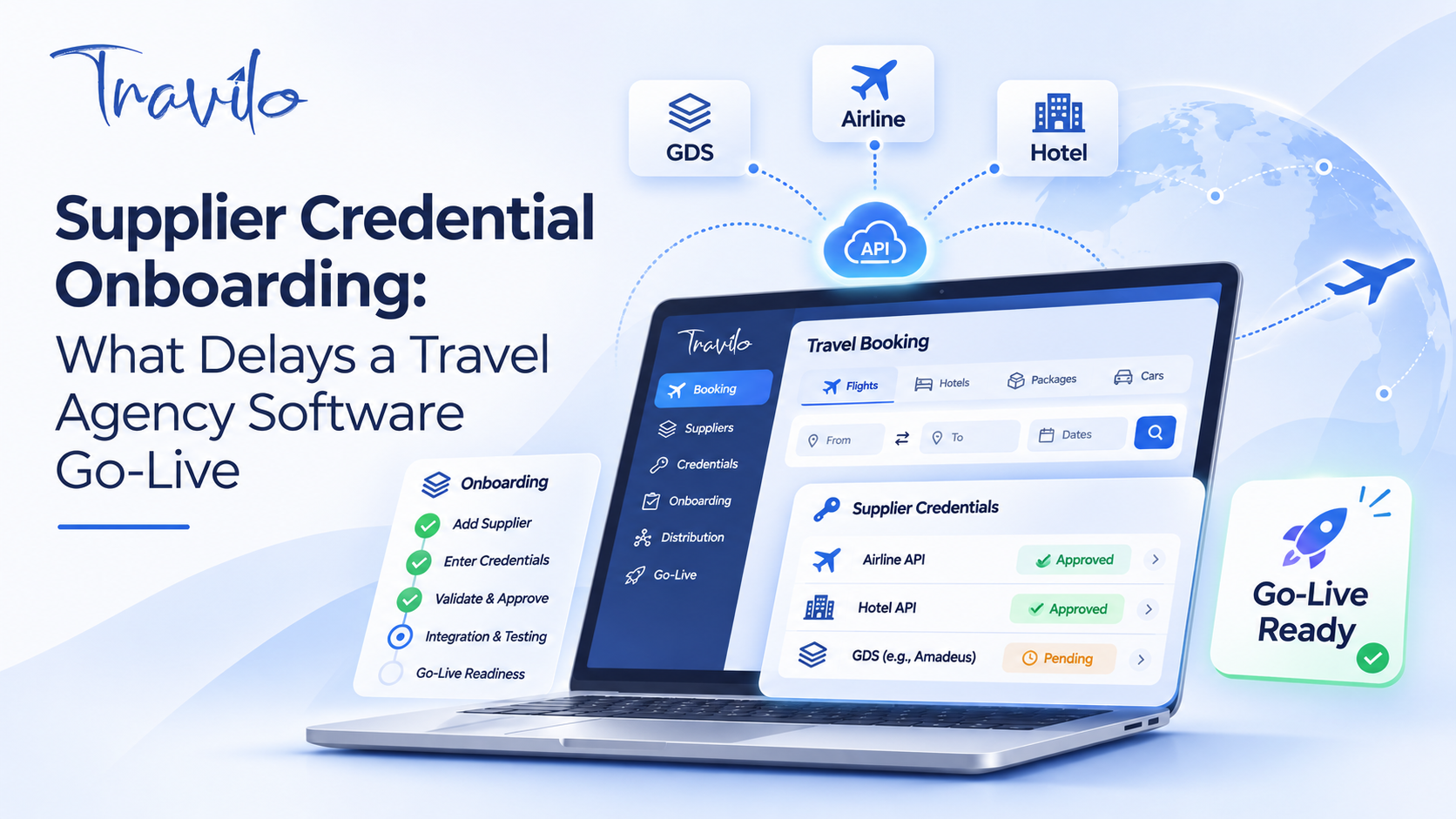
Your travel agency software may be configured, branded and technically ready.
But that does not necessarily mean your agency can start selling tomorrow.
A GDS connection may still be waiting for production credentials. An airline API may require commercial approval. A supplier account may work in a sandbox but not in production. A payment method may still need activation. Your office ID, PCC, market configuration, currency or ticketing authority may not yet match the live setup.
This is where supplier credential onboarding becomes one of the most important parts of a travel software implementation.
For agencies, consolidators and OTA teams, go-live is not only a software milestone. It is a dependency milestone.
The platform, suppliers, credentials, finance setup, user access, fare rules and servicing workflow all need to work together before the first real booking can safely move through the system.
This guide covers seven common supplier credential onboarding issues that can delay a travel agency software launch, what your team should prepare and what should be tested before production go-live.
What Is Supplier Credential Onboarding?
Supplier credential onboarding is the process of preparing, approving, configuring and validating the access required for a travel platform to connect with external inventory or service providers.
Depending on the connection, that may involve:
GDS credentials
PCC or office identifiers
airline or supplier API credentials
NDC access
hotel supplier credentials
market or point-of-sale configuration
agency identifiers
commercial agreements
payment or settlement setup
production API keys
test credentials
permission scopes
The technical API connection is only one part of the process.
A supplier may have a working API, but your agency still needs the commercial right and correct credentials to access the relevant content.
That distinction matters.
IATA's New Distribution Capability (NDC) is designed to improve communication between airlines and travel sellers through modern distribution standards. But having an NDC-capable platform does not automatically mean every airline's content is immediately available to every agency.
Actual access can still depend on the distribution path, airline or supplier relationship, agency identification, market setup, credentials and commercial arrangements.
So when evaluating travel agency software, do not ask only:
“Can the platform connect to this supplier?”
Ask:
“Can our agency use this connection with our credentials, market, commercial setup and servicing requirements?”
That question is much closer to what determines a successful launch.
Why Supplier Connections Delay Travel Software Go-Live
Travel technology implementations depend on parties outside the software vendor.
A platform team can configure the system, but it cannot always issue a supplier credential on behalf of an airline, GDS, bedbank, aggregator or payment provider.
This creates an important difference between:
Software readiness
and
Operational readiness
Software readiness may mean the platform, user roles, branding, workflows, pricing rules and required modules are configured.
Operational readiness means the agency can actually:
search live inventory
receive the expected fares
revalidate pricing
create bookings
issue tickets where permitted
process the expected payment method
access required post-booking services
reconcile transactions
operate under the correct market configuration
A technically complete platform can therefore still miss its go-live date because one external dependency remains unresolved.
1. GDS Credentials Arrive Late
One of the most common go-live dependencies is GDS access.
Your agency may already have a commercial relationship with a GDS, but the software implementation can still require the correct production configuration.
Depending on the provider and operating model, this may involve:
office ID or PCC
agency credentials
market configuration
ticketing permissions
branch setup
queue configuration
currency
point of sale
application or user access
The exact requirements vary by provider agreement and agency setup.
This is why supplier credential onboarding should begin early, not during the final week of testing.
What the Agency Should Prepare
Before the implementation reaches final testing, establish:
which GDS will be used
whether production access already exists
relevant PCC or office information
markets where bookings will be made
ticketing authority where required
who can securely coordinate credentials
who inside the agency owns communication with the provider
The implementation team should not become the only party chasing the GDS.
Someone inside the agency needs to own that dependency.
If you are comparing different distribution options, review the practical differences between GDS and supplier API connectivity for B2B booking against the production setup that will actually apply to your agency.
2. The Supplier Contract Exists, but API Access Does Not
Having a commercial relationship with a supplier does not always mean production API access is already active.
An agency may have:
portal access but no API credentials
test credentials but no production credentials
API documentation but pending commercial approval
access to one product but not another
credentials tied to another market or entity
This can affect airlines, hotels and other travel inventory providers.
A common procurement mistake is seeing a supplier logo in a software presentation and assuming that connection will immediately be available to your agency.
That assumption can cause problems.
Actual availability may depend on:
your agency's supplier agreement
market
currency
point of sale
supplier approval
credentials
enabled product scope
commercial terms
Supplier compatibility should therefore be checked against your actual agency setup before a fixed go-live date is agreed.
3. Sandbox Credentials Work, Production Credentials Do Not
A successful sandbox test is useful.
It is not proof that production will behave exactly the same way.
A test environment may support actions such as:
search
booking
cancellation
test payment
simulated ticketing
Production can involve different:
inventory
fare availability
permissions
commercial restrictions
payment behaviour
timeouts
cancellation rules
servicing capabilities
That means supplier credential onboarding should not end when sandbox testing passes.
There should be a separate production-readiness stage.
What Production Validation Should Test
Once live credentials are available, verify the actual workflow that matters to the agency:
authentication
live search
expected inventory
fare availability
price revalidation
booking creation
supplier confirmation
ticketing where applicable
cancellation
void, refund or reissue workflow where supported
timeout handling
duplicate prevention
finance records
reporting
Testing should include both success and failure cases.
A production connection needs to behave safely when something goes wrong, not only when every supplier response is perfect.
4. Agency Identification Is Not Ready
Travel distribution depends heavily on identifying who is selling.
An airline, GDS or other supplier may need to know the agency, market, branch or seller behind a transaction.
Depending on the commercial model, formal travel-agent accreditation or other agency identification may also be relevant.
IATA Travel Agent Accreditation provides an industry framework through which accredited agencies can establish recognized relationships with participating airlines, including identification and relevant ticketing and payment arrangements.
For a travel agency software implementation, the practical lesson is simple:
Do not leave agency identity and accreditation dependencies until the end.
Your onboarding checklist should establish:
legal agency entity
operating market
agency identifier where required
accreditation status where relevant
branch or office information
supplier account owner
commercial contact
technical contact
If these details are still changing while production credentials are being configured, go-live can easily be delayed.
5. NDC or Direct Airline Access Needs Separate Readiness Checks
NDC is not simply another name for a GDS connection.
The distribution path matters.
An agency may access airline content through different routes, including:
direct airline connectivity
aggregators
GDS or other distribution partners supporting NDC content
Therefore, NDC readiness should be checked against the actual connection being used.
If your agency expects content from a specific airline, confirm:
how that content will reach the platform
who provides the required credentials
whether the agency has the required commercial access
which market or point of sale applies
which booking functions are available
which post-booking functions are available
whether payment and settlement workflows are ready
Supplier credential onboarding for NDC should therefore be treated as both a commercial and technical workstream.
It should not be reduced to “the API has been connected.”
6. Payment and Finance Setup Is Not Ready
A supplier connection can work while the booking operation still fails because the finance setup is incomplete.
The production workflow may need to account for:
supplier credit
payment method
agency wallet or deposit
card payment
settlement flow
currency
refund handling
finance or ledger records
For B2B travel operations, the agency may also need to manage partner-side controls such as:
wallet balance
credit
hold balance
due dates
deposit approval
partner-level pricing
Travilo's verified B2B operating scope includes partner wallet and credit workflows, deposits, pricing and commission controls, partner onboarding and booking operations.
But an internal travel platform cannot replace commercial readiness on the supplier side.
A production booking should therefore be tested through the complete flow:
Search → Fare → Booking → Payment/Credit → Confirmation → Ticketing → Finance Record
Do not stop testing after “booking successful.”
If the booking is successful but finance cannot reconcile it, the workflow is not fully ready.
Supplier readiness is also only one part of a B2B rollout. Your agency should complete B2B travel partner onboarding, including partner approval, organisation setup, roles, access and finance activation before agents begin live booking.
7. Nobody Owns the Credential Dependency
Many supplier onboarding delays are not software problems.
They are ownership problems.
The software company assumes the agency is speaking with the supplier.
The agency assumes the implementation team is handling everything.
The supplier asks for another document.
Nobody follows up.
The go-live date moves.
Every important supplier dependency should therefore have a named owner.
A simple tracker can look like this:
Dependency | Owner | Status | Needed for |
|---|---|---|---|
GDS production credentials | Agency / GDS contact | Pending | Flight search and ticketing |
Airline / NDC access | Agency / airline or provider | Pending | Relevant airline content |
Supplier API credentials | Supplier / agency | Received | Production access |
Payment credentials | Finance / payment provider | Testing | Booking payment |
Point-of-sale configuration | Agency + implementation team | In review | Correct content and fare setup |
Production workflow test | Implementation + operations | Not started | Go-live |
The specific owners will differ between businesses.
What matters is that the dependency cannot disappear between teams.
Supplier Credential Onboarding Checklist Before Go-Live
A practical supplier credential onboarding review should happen before launch.
Commercial Readiness
Confirm:
supplier agreement is active
correct agency entity is approved
relevant identification or accreditation is available
market and point of sale are confirmed
commercial scope is understood
Credential Readiness
Confirm:
production credentials have been received
office ID or PCC is configured where required
production endpoint or environment is confirmed
credentials have been tested
credential ownership is documented
expiry or rotation process is understood where applicable
Content Readiness
Confirm:
expected suppliers appear
required routes or markets can be searched
expected fare or content types are available
currency is correct
applicable ancillaries can be accessed where supported
Booking Readiness
Test:
search
fare revalidation
booking
confirmation
ticketing where applicable
cancellation
applicable void, refund and reissue workflows
Finance Readiness
Confirm:
expected supplier payment or balance setup
partner wallet or credit rules
payment gateway where applicable
deposit handling
finance records
refund reconciliation
Operations Readiness
Confirm:
who handles supplier errors
who owns credential issues
escalation contacts
failed-booking process
duplicate-booking controls
support process
A travel platform should not be declared ready simply because users can log in.
It should be considered operationally ready when the required production workflow can be completed and reviewed end to end.
What a Realistic Go-Live Test Should Look Like
The strongest go-live test is not a presentation.
It is a realistic transaction.
Ask the implementation team to run a complete booking through the actual production setup.
For example:
Search a route the agency regularly sells.
Confirm the expected supplier content appears.
Select a real fare.
Revalidate the price.
Apply the relevant agency or partner pricing rule.
Create the booking.
Use the intended payment, wallet or credit workflow.
Confirm the booking.
Issue the ticket where permitted.
Verify the finance record.
Test an applicable post-booking action.
Confirm the transaction appears correctly in relevant operational views or reports.
Then test what happens when something goes wrong.
Examples include:
fare changes after search
insufficient credit
supplier timeout
booking failure
duplicate retry
cancellation request
refund request
invalid credentials
This failure testing matters because live travel operations are not made up only of successful bookings.
The system and operating process also need to handle exceptions clearly.
If you are still comparing platforms, use this travel booking software guide for agencies alongside your supplier-readiness checklist.
How Travilo Fits Into Supplier Connectivity
Travilo is designed around B2B-first travel operations, with B2C and administrative workflows also supported within the broader platform.
Its verified travel operating scope includes:
flight search and booking
supplier connectivity architecture
partner onboarding and management
wallet, deposit and credit workflows
pricing and commission controls
ancillary services
booking and ticketing workflows
void workflows
refund workflows
reissue workflows
operational support functions
The useful point here is not simply the number of integrations a platform can mention.
A supplier connection becomes valuable when it works with the rest of the agency's operating model.
That includes:
B2B agents and sub-agents
pricing rules
booking workflows
wallet and credit controls
ancillary services
after-sales processes
finance workflows
operational visibility
Connection availability still depends on the relevant supplier agreement, credentials, approval and market setup.
Travilo does not remove those external commercial dependencies.
Instead, it provides the operating platform in which approved supplier connectivity can work alongside the rest of the agency workflow.
For agencies evaluating travel agency software, that creates a more useful buying question.
Instead of asking:
“How many APIs does the platform have?”
Ask:
“Can our approved supplier connections support the way we actually search, sell, service and reconcile bookings?”
You can explore Travilo to review how supplier connectivity fits with booking, B2B partners, pricing, payments and after-sales workflows.
Supplier Connectivity Should Be Evaluated Before You Sign
Supplier credential readiness should not first be discovered after the software contract is signed.
Before selecting a platform, ask the vendor to clarify:
which required suppliers are already supported
which connections require additional implementation
which credentials must come from the agency
which approvals sit outside the software vendor's control
what test and production environments are available
what production validation will be required
who owns each dependency
This helps separate two very different questions:
Can the software technically connect?
and
Can our agency commercially and operationally use that connection?
They are not the same.
A platform can be technically capable while the agency itself is not yet production-ready.
Frequently Asked Questions
What Is Supplier Credential Onboarding in Travel Software?
Supplier credential onboarding is the process of preparing and validating the approvals, agency identifiers, production credentials, market settings and technical access required for a travel platform to use relevant GDS, airline or other supplier connections.
Why Can Supplier Credentials Delay a Travel Agency Software Launch?
The software platform may be configured while an external dependency remains pending. Production credentials, office or PCC setup, supplier approval, ticketing permissions, payment setup or market configuration can all affect production readiness.
Does Having a Supplier API Mean My Agency Can Use It Immediately?
Not necessarily.
Technical support for an API and commercial access to that supplier are different things.
Actual usage can depend on your agreement, credentials, market, approval, enabled products and other supplier-specific conditions.
What Should Be Tested After Production Credentials Are Received?
At minimum, test authentication, search, price revalidation, booking, confirmation, payment or credit handling, ticketing where relevant, applicable post-booking workflows, failure handling and finance reconciliation.
Do GDS and NDC Connections Always Use the Same Setup?
No.
GDS, direct airline, NDC aggregator and other supplier connections can follow different commercial and technical models.
The actual access path needs to be confirmed for each connection.
Can Travilo Use an Agency's Supplier Connections?
Travilo supports supplier connectivity as part of its travel operating platform. Final availability for a specific agency depends on the applicable supplier, credentials, approvals, commercial agreement and market configuration.
What Is a Common Travel Software Go-Live Mistake?
One major mistake is treating supplier onboarding as an API task only.
A stronger go-live process tracks technical access, commercial approval, production credentials, finance readiness, operational testing and ownership separately.
Do Not Set a Go-Live Date Before You Know the Dependencies
A realistic travel software launch date should be based on dependencies, not only development progress.
Software configuration can move quickly.
Supplier approval may not.
Credential activation may not.
Payment setup may not.
Production testing can uncover issues that were invisible in a sandbox.
That is why supplier credential onboarding should start early, have a named owner and remain visible throughout implementation.
Before your agency starts a new travel platform rollout, review:
supplier requirements
GDS setup
production credentials
operating markets
payment model
B2B finance rules
booking workflow
servicing requirements
Then ask the vendor to demonstrate the production workflow that matters to your business, not only a generic demo.
If you are planning a new travel platform rollout, review Travilo and map your supplier, GDS, payment, booking and servicing dependencies before fixing the go-live date.