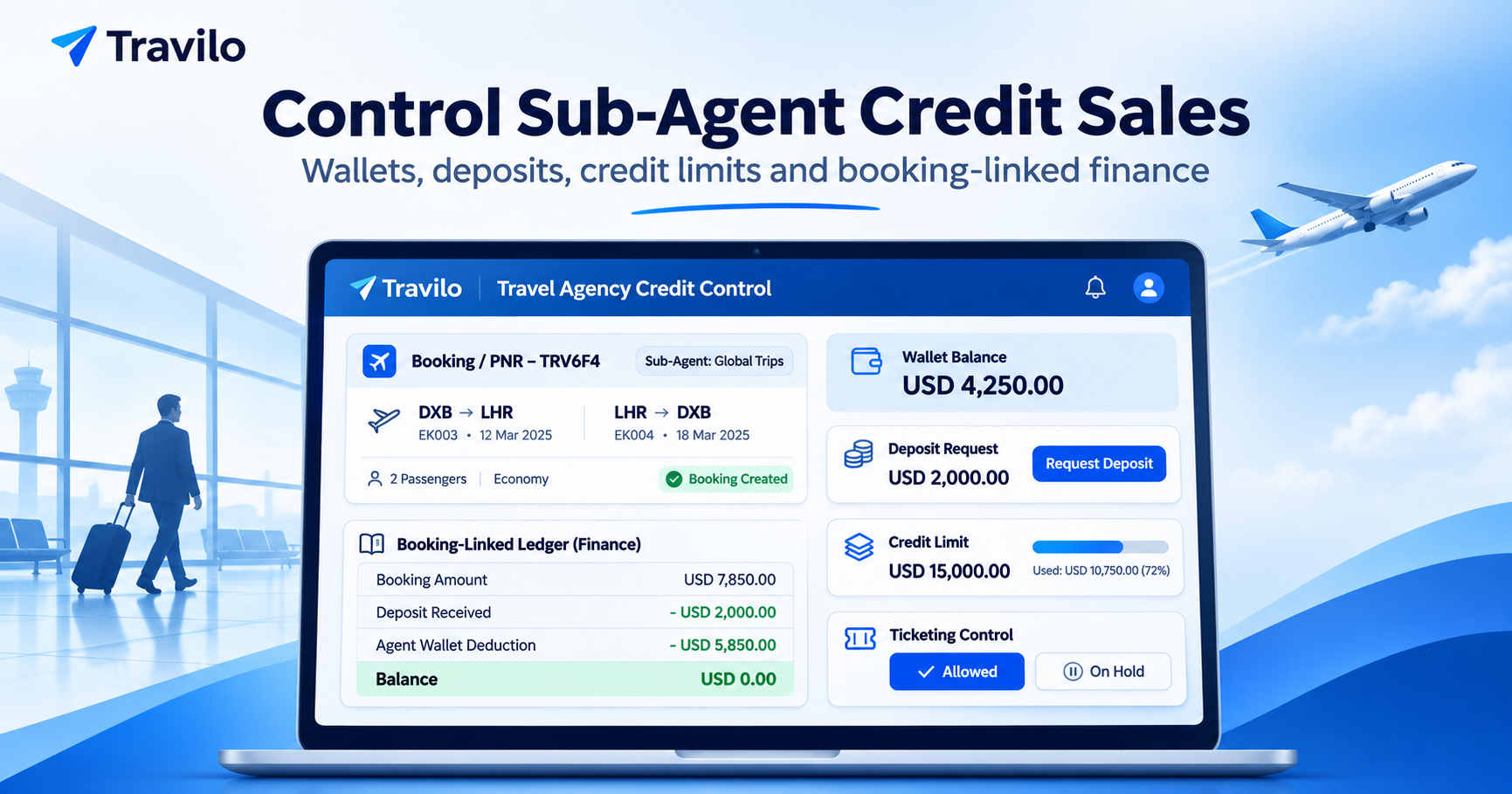
Credit risk in a travel agency usually starts before finance sees it.
A sub-agent creates a booking. The fare needs to be ticketed quickly. The wallet balance is low, but someone says the payment is coming. The booking moves forward while the funding decision sits in WhatsApp, a spreadsheet, or someone's memory.
That is where agencies lose control.
Good travel agency credit control software keeps the commercial decision close to the booking. Wallet balance, deposits, credit limits, ticket status, partner access and transaction records should be visible before the agency takes on more exposure.
For a B2B travel business, credit control is not only an accounting job. It is part of the booking workflow.
Why Sub-Agent Credit Becomes Difficult to Control
Most credit problems are not caused by one large default. They build through small exceptions.
A regular agent is allowed to book before topping up. A deposit is expected but has not reached the account yet. A ticket is issued because the passenger is waiting. Finance plans to reconcile everything later.
Each exception may look manageable on its own. Across dozens of bookings and multiple agents, the agency can quickly lose track of who owes what and which transactions have already moved to ticketing.
The problem becomes harder when the information is split across different systems:
bookings in one portal
agent balances in a spreadsheet
deposit confirmations in chat
credit limits in another file
ticket changes with the operations team
financial entries checked later by accounts
This is why effective sub-agent management needs to be connected to booking and finance operations rather than managed as a separate partner list.
Before a ticket moves forward, the team should be able to answer a simple question:
Does this partner have enough funded balance or approved credit capacity for this transaction?
What Should Be Connected Before a Credit Sale Moves Forward?
Credit control becomes much easier when the financial position of the partner stays connected to the booking itself.
Record | What the team needs to know |
|---|---|
Booking / PNR | What the sub-agent has booked or requested |
Ticket status | Whether the booking is on hold, ready for issue or already ticketed |
Wallet balance | How much funded value is currently available |
Deposits | Whether additional funds have been submitted or recorded |
Credit limit | How much controlled credit capacity the partner has |
User permissions | What the agent or staff member is allowed to do |
Transaction history | How deposits, debits, and adjustments have moved |
Ledger record | How the financial activity relates to the booking |
When these records are connected, the agency does not have to reconstruct the decision after the ticket has already been issued.
The team can decide whether the booking should move forward, wait for funding, or remain within the partner's configured credit arrangement.
Wallets, Deposits and Credit Limits Do Different Jobs
Agencies often treat wallet balance and credit limit as if they solve the same problem. They do not.
A stronger B2B control model uses each one for a specific purpose.
Wallet balance represents funded selling capacity. The agent can transact against money that is already available.
Deposits replenish that capacity and create a visible funding trail.
Credit limits provide selected partners with controlled room to operate beyond their funded balance.
Transaction and ledger records show how that financial position changed over time.
This makes the relationship much clearer than simply telling an agent, "You can pay us later."
A defined travel agent credit limit turns that informal promise into a measurable operating rule.
Example: A Sub-Agent Is Short on Balance
Consider a simple booking.
A sub-agent finds a fare and confirms the passenger wants to proceed. The booking value is higher than the available wallet balance.
Before ticketing, the agency needs to know:
how much balance is available
whether a deposit has been added
whether the agent has an available credit limit
whether the transaction fits within that limit
whether the user has permission to proceed with ticketing
The important point is not that every agency must use the same policy.
The important point is that the policy should be visible inside the operational workflow instead of being handled through separate messages and spreadsheets.
Partial Payments Need Their Own Rules
Partial payments can be useful when an agency wants to keep a booking moving while the remaining amount is still due.
But partial payment should not become another name for uncontrolled credit.
The agency needs a clear policy around questions such as:
Which partners can use partial payment?
How much must be funded before the transaction can move forward?
How is the remaining balance tracked?
Who is allowed to continue the booking or ticketing process?
How will finance identify the outstanding amount later?
When the answer to these questions depends on someone's memory, the agency is carrying hidden exposure.
When partial-payment activity stays connected to partner balances, transaction history, and booking progress, both operations and finance can work from the same record.
Ticketing Permission Is Part of Credit Control
A credit limit has limited value if every user can still move a booking through the same actions.
Access control matters because searching, booking, and ticketing do not create the same level of financial exposure.
For example, an agency may want a sub-agent to search fares and create bookings while keeping ticketing under tighter control.
That gives the business another layer of protection beyond wallet balance alone.
The credit-control model then becomes:
Partner access → Booking → Funding position → Ticketing authority → Financial record
This is much stronger than checking balances only at the end of the day.
Credit Risk Changes Once the Ticket Is Issued
Credit control does not end when the booking becomes a ticket.
Once issuance happens, the agency may also have to manage:
void requests
refunds
reissues
penalties or additional collections
changes in the amount owed by the agent or traveller
That means the financial history should remain connected to the original booking throughout the ticket lifecycle.
If ticketing and finance are disconnected, staff may know that a refund or reissue happened without immediately seeing how it affected the partner's balance or the transaction history.
A booking-linked travel agency accounting software setup makes reconciliation easier because finance does not have to rebuild the transaction from several systems later.
The same principle applies when evaluating ticket booking software for travel agents. Ticketing functionality alone is not enough for a B2B agency. The commercial and financial context around the ticket matters too.
A Practical Sub-Agent Credit Control Workflow
A useful workflow can be kept straightforward.
1. The Agent Searches and Creates the Booking
The booking begins under the correct partner account, so the agency knows which agent owns the transaction.
2. The System Shows the Partner's Funding Position
The team can review the available wallet balance, deposits and configured credit position before the booking moves further.
3. The Booking Is Checked Against the Agency's Rules
If there is enough funded balance, the transaction can follow the normal process.
If the balance is short, the team can determine whether the partner needs to add funds or whether the booking falls within the agency's configured credit arrangement.
4. Ticketing Follows the Allowed Access
The agency controls which users or partners can move from search and booking into ticketing.
5. The Financial Activity Remains Traceable
Deposits, debits, balances and transaction records remain available for finance and operations to review.
6. Post-Ticket Changes Stay Connected
If the booking later requires a void, refund or reissue, the service activity remains connected to the booking history rather than becoming a separate manual record.
This is what makes credit control operational rather than reactive.
How Travilo Supports Sub-Agent Credit Control
Travilo connects the areas that matter when an agency sells through B2B partners.
Relevant capabilities include:
B2B agent and sub-partner access
agent wallet balances
deposit workflows
configured credit limits and credit balances
partial-payment support
role-based user access
flight search, booking and ticketing workflows
void, refund and reissue management
transaction and ledger visibility
operational reporting
The value comes from how those areas work together.
Instead of asking finance to check one system while ticketing works in another, the agency can keep partner funding, booking progress and transaction records closer to the same operational flow.
For agencies reviewing different travel agency software options, this is worth testing during the demo rather than simply checking whether the software has a "credit limit" field.
What to Test in a Credit-Control Software Demo
Use a real scenario.
Ask the vendor to create a sub-agent with limited wallet balance and a defined credit arrangement. Then run one booking from search through ticketing.
During the demo, check whether you can clearly see:
which agent owns the booking
the available wallet balance
deposits and transaction activity
the configured credit position
who can proceed with ticketing
how the financial record changes after the transaction
what happens if the ticket later needs a refund or reissue
That demonstration will tell you more than a long feature list.
The question is not whether the platform has wallets, credit, and ticketing somewhere in the menu.
The question is whether those controls work together before the agency takes on financial exposure.
Credit Control Should Help You Grow, Not Slow Every Booking Down
A growing sub-agent network creates more sales opportunities, but it also creates more financial decisions.
The agency needs enough flexibility to serve trusted partners without turning every booking into a manual finance discussion.
That is the real role of travel agency credit control software.
It should give the business a clear view of partner funding, controlled credit, booking progress, ticketing access and transaction history while the work is happening.
When those records stay connected, the agency can make faster decisions without losing visibility over cash exposure.
See the Workflow in Travilo
Want to test the process with a real B2B booking scenario?
Explore the Travilo live demo and review how agent access, bookings, wallets, credit and financial activity can fit into one operating flow.
Frequently Asked Questions
What is travel agency credit control software?
Travel agency credit control software helps a travel business control credit sales made through agents or sub-agents. It connects partner balances, deposits, credit limits, booking progress, ticketing access and financial records so the agency can review exposure as transactions move forward.
How do wallets and deposits reduce sub-agent credit risk?
Wallets show funded selling capacity, while deposits add money to that capacity with a visible transaction trail. This reduces the need to rely entirely on informal pay-later arrangements and gives the agency a clearer funding position before ticketing.
What is the difference between an agent wallet and a credit limit?
A wallet represents funded value already available to the agent. A credit limit defines how much additional exposure the agency is prepared to allow under its own commercial rules. Agencies can use the two together rather than treating them as the same control.
Should travel agencies allow partial payments?
They can, but the agency should define how partial payments are handled, how the outstanding amount is tracked, and what conditions must be met before the transaction moves further. Without clear rules, partial payment can turn into unmanaged credit.
Can different sub-agents have different credit limits?
Yes. A B2B agency may configure different commercial arrangements for different partners based on its own operating policy. Credit should not have to be identical across the whole agent network.
Why should ticketing permissions be connected to credit control?
Because searching, booking and issuing a ticket create different levels of commitment. Restricting access by role or user gives the agency another layer of control when funding or credit conditions have not been met.
What should I ask to see during a software demo?
Ask for one complete workflow: create a sub-agent, set the wallet or credit position, search a flight, create the booking, review the available funding, move to ticketing, and then show how the transaction appears in the financial record. If possible, also test a refund or reissue scenario.