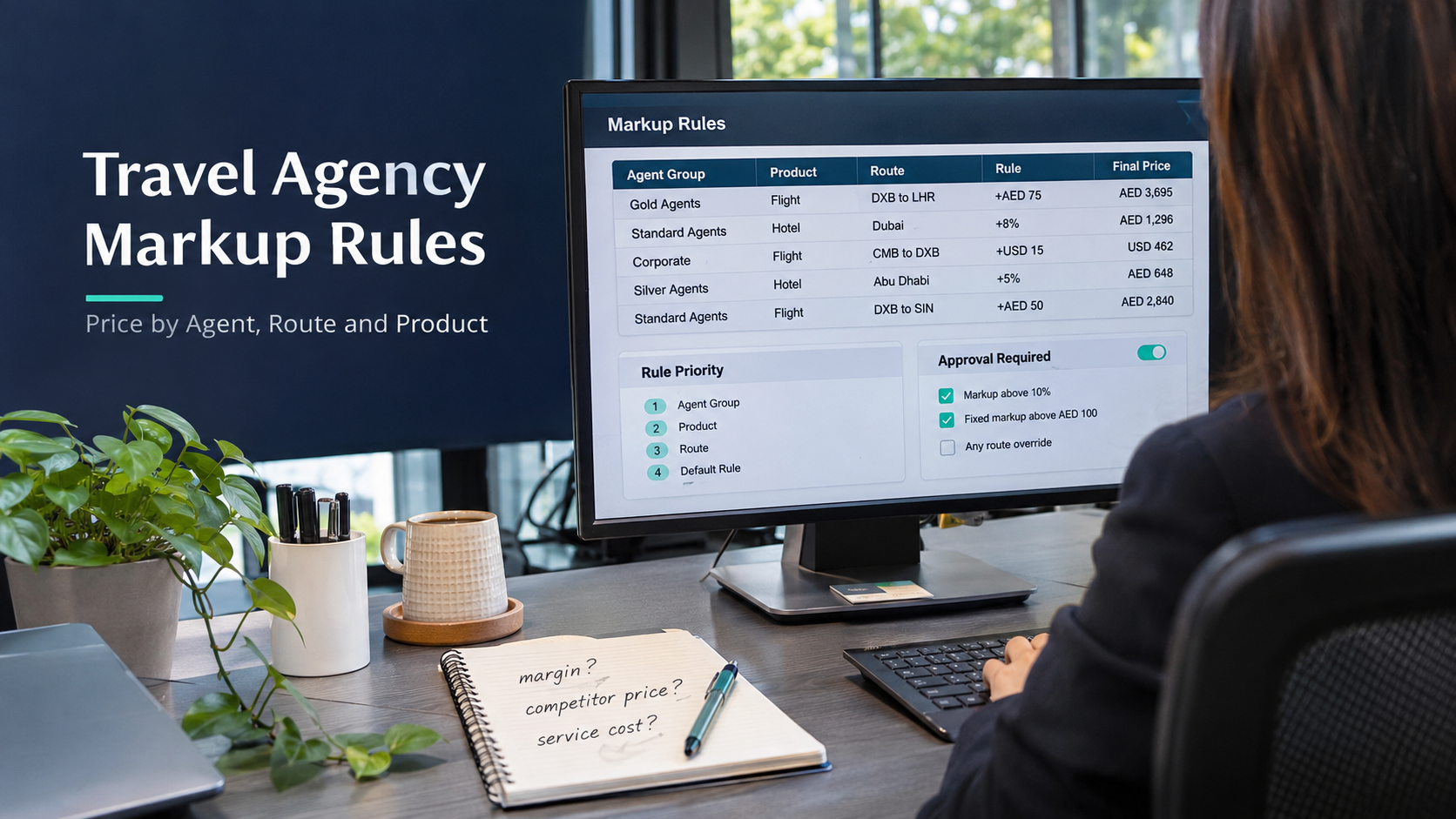
Travel agency markup rules determine how supplier cost becomes the price shown to a customer or sub-agent. A good rule protects margin without making every fare, room or package uncompetitive. A weak rule applies the same percentage everywhere, hides conflicts between pricing layers and leaves finance unable to explain the final amount.
Growing agencies need more control than one default markup. A consolidator may price Gold agents differently from new partners, use a fixed amount on competitive air routes, apply a percentage to net hotel rates and require approval when a user changes the result.
This guide explains how to build travel agency markup rules by agent, route and product, decide which rule wins when several conditions match and preserve a complete pricing trail from supplier cost to final settlement.
What Are Travel Agency Markup Rules?
A markup rule is an instruction that adds an approved amount to the agency's underlying cost before the offer is sold. The amount may be fixed, percentage-based, tiered or calculated from several commercial conditions.
A basic selling-price formula is:
Customer price = supplier cost + agency markup + applicable service fees + taxes or payment charges
The formula looks simple, but each component needs a clear definition. Supplier cost may already include taxes. A card charge may be absorbed or passed on where permitted. A sub-agent may add its own retail margin. A refund may reverse some amounts but not others.
The booking record should therefore preserve the supplier cost, each applied rule, every override, the final selling price and later financial changes.
Markup, Commission and Service Fee Are Different
| Pricing component | Who creates or pays it? | How it appears |
|---|---|---|
| Markup | The agency adds it to underlying cost | Usually included in the selling price |
| Commission | A supplier or master agency pays or shares it under an agreement | May be earned after sale or settlement |
| Service fee | The customer pays for ticketing, planning, support or another service | May appear separately on the quotation or receipt |
| Discount | The agency reduces its selling price or funded promotion | Shown as a reduction from the calculated price |
Do not merge these into one number. Separate records make it easier to calculate earned revenue, explain a quotation and process a refund accurately.
IATA's Travel Agent Service Fee service is one example of why the distinction matters. It allows participating BSP agents to process a service fee associated with a ticket while keeping it identifiable as a separate transaction.
For a wider pricing discussion, see Travilo's guide to travel agency markup strategy.
Why One Markup Rule Usually Fails
The same rule rarely fits every sale because the commercial conditions change.
- A high-volume partner may receive a lower operator markup than a new agent.
- A competitive flight route may need a fixed amount rather than a percentage.
- A net hotel rate can usually support percentage pricing more naturally than a public air fare.
- A complex multi-city itinerary may require a service fee for the additional work.
- A low-cost carrier booking may carry different payment and servicing costs.
- A package may need separate internal margins for hotel, transfer and activity components.
Effective travel agency markup rules reflect these differences while remaining simple enough for finance and operations to audit.
The Main Dimensions of a Markup Rule
1. Agent or Agent Group
Set pricing by individual partner only when the contract genuinely differs. Otherwise, use groups such as Gold, Standard, New, Corporate or Overseas. Group pricing is easier to maintain and reduces accidental inconsistency.
When an agent changes group, define whether the new rule applies only to future searches or also to held but unconfirmed bookings.
2. Product
Flights, hotels, tours, transfers, visas and insurance have different cost structures. Build separate product rules before adding more detailed conditions.
- Flights: Fixed or tightly capped markup often suits price-sensitive routes.
- Hotels: Percentage markup can scale with net room value.
- Packages: A blended contribution target may cover several components.
- Visa services: A disclosed service fee may reflect processing work.
- Transfers and activities: Percentage pricing with minimum amounts can protect small bookings.
3. Route or Destination
Route-level rules help agencies respond to competition, service workload and local demand. A Dubai to London fare may have different pricing pressure from a regional route with limited alternatives. Hotel rules may vary by city, country or zone.
Avoid creating hundreds of route exceptions without owners and expiry dates. Use them only where the commercial difference is meaningful.
4. Supplier or Content Source
The same product can arrive through a GDS, NDC connection, LCC API, hotel bedbank or direct contract. Supplier terms, payment cost, cancellation risk and support workload can differ. The pricing engine should retain the selected source so finance can explain the result.
5. Booking Value
Value bands keep percentage rules within sensible limits. For example:
- Up to AED 1,000: fixed AED 40
- AED 1,001 to AED 5,000: 4% with a maximum of AED 150
- Above AED 5,000: approval or contract-specific pricing
6. Cabin, Room or Fare Type
Economy, business class, refundable fares, promotional rates and different hotel room plans can carry different margin capacity and servicing risk. Use these attributes only when the source data is reliable and consistently mapped.
7. Sales Channel and Service Level
B2B, B2C, corporate and counter sales may need different prices. A self-service portal booking may cost less to serve than an itinerary requiring an account manager, after-hours assistance and negotiated reporting.
Choose the Right Calculation Method
The calculation method determines how travel agency markup rules respond when booking values and servicing costs change.
Fixed Markup
Add a set amount, such as AED 75 per ticket. Fixed markup is easy to explain and works well when the servicing effort is similar across transactions.
Percentage Markup
Add a percentage of supplier cost. This fits many hotel and net-rate products but can become too high on expensive bookings. Use minimum and maximum values.
Tiered or Banded Markup
Apply a different amount or percentage at defined booking values. Banded rules can protect contribution on small sales without overpricing large transactions.
Minimum and Maximum Markup
A floor prevents the contribution from becoming too small. A cap prevents a percentage from making an expensive offer uncompetitive.
Dynamic Markup
Dynamic pricing selects a rule using approved variables such as agent group, route, product, supplier, booking value or service level. It should still operate within defined limits and show which conditions produced the price.
Define Rule Priority Before Going Live
Several travel agency markup rules may match one search. Without a priority model, the system may stack them unexpectedly or choose an arbitrary result.
A practical priority order is:
- Approved contract-specific rule for an individual agent or corporate account
- Agent group plus product plus route rule
- Agent group plus product rule
- Route or destination rule
- Product and supplier rule
- Product default
- Agency-wide fallback
Manual overrides should not silently sit above this hierarchy. Treat them as controlled exceptions with permission, reason, old value, new value, user and timestamp.
Decide whether rules replace or stack. Replacement is usually easier to audit. If stacking is required, document the order, such as operator markup first, approved sub-agent retail markup second and disclosed service fee last.
Worked Example 1: B2B Flight Pricing
A Dubai consolidator receives a DXB to LHR fare with a total supplier cost of AED 3,600.
- Gold Agent flight rule: fixed AED 75
- Master agency price to sub-agent: AED 3,675
- Approved sub-agent retail markup: AED 50
- Final customer price: AED 3,725
The booking should retain AED 3,600 as supplier cost, AED 75 as master agency markup and AED 50 as the sub-agent's retail layer. Combining the two into AED 125 would make partner settlement and revenue reporting harder to explain.
Worked Example 2: Hotel Percentage With Limits
A hotel supplier returns a net rate of USD 420. The Standard Agent rule is 8%, subject to a minimum of USD 25 and a maximum of USD 60.
USD 420 × 8% = USD 33.60
The calculated markup falls within the allowed range, so the price to the agent is USD 453.60 before any separately disclosed fee or tax adjustment.
If the net rate were USD 100, the 8% result would be USD 8, so the USD 25 minimum would apply. If the net rate were USD 1,000, the calculated USD 80 would be reduced to the USD 60 cap.
How Pricing Works Across a B2B Agent Hierarchy
A B2B network may contain the platform, master agency, sub-agent, booking user and final traveller. Each layer needs a clear view of the amount it is allowed to see and change.
The master agency controls supplier access, minimum margin and partner pricing. The sub-agent may receive permission to add a retail markup within a limit. The booking user should not automatically receive permission to edit commercial rules.
This follows the NIST principle of least privilege, which limits a user's access to what is necessary for assigned tasks.
Travilo's guide to sub-agent management explains how pricing, permissions, credit and ledger controls fit inside the same hierarchy. For the portal architecture, review Travilo B2B travel portal software.
Connect Markup With Credit, Wallet and Ledger
Pricing cannot operate separately from financial control. Before a B2B booking proceeds, the platform should know:
- The supplier cost and selected pricing source
- The master agency markup
- The partner's allowed retail layer
- The agent's wallet and available credit
- The amount reserved or debited
- The payment and settlement status
- The ledger entries created by the transaction
A correct price with an uncontrolled credit process can still create a loss. Travilo's guide to travel agency credit control shows how wallet, deposits, limits and ticketing permissions work together.
Control Manual Overrides
Even well-designed travel agency markup rules need a controlled exception process for unusual commercial cases.
Overrides are sometimes necessary for a contract, price match, group request or service recovery. They should never erase the original calculation.
Require the system to store:
- The original rule and price
- The proposed replacement
- The reason code and note
- The requesting user
- The approver
- The date and time
- The effect on expected contribution
Set approval thresholds for a price below minimum contribution, a discount above a limit or a manual increase that may create customer risk.
Handle Voids, Refunds and Reissues Correctly
The original quoted margin is not always the final earned margin. A later transaction may introduce supplier penalties, service work, partial refunds, exchange differences or non-refundable fees.
Keep the original supplier cost, markup, service fee, supplier credit, customer refund and reissue collection connected to one booking. When the case closes, calculate actual contribution from the final values.
Do not automatically refund a service fee or markup without checking the disclosed policy, supplier transaction and applicable law. The system should support the approved policy, while qualified advisers confirm its legal and accounting treatment.
Reports That Show Whether Markup Rules Work
Review more than gross booking value. The reporting layer should show whether travel agency markup rules protect contribution without damaging conversion. Useful reports include:
- Contribution per booking after payment and servicing cost
- Margin by agent group, product, route and supplier
- Conversion rate by final price band
- Manual override frequency and value
- Discounts by user and reason
- Refund-adjusted revenue
- Negative-margin or below-floor bookings
- Rules that have not been reviewed by their expiry date
A profitable rule should create adequate contribution without damaging conversion or partner growth. Review both outcomes together.
Markup Rule Setup Checklist
- Define supplier cost consistently for every product.
- Separate markup, commission, service fee and discount.
- Create product-level defaults.
- Group agents according to real commercial agreements.
- Add route and supplier exceptions only where justified.
- Set minimums, maximums and value bands.
- Document rule priority and stacking behaviour.
- Restrict editing and override permissions.
- Connect price calculation to wallet, credit and ledger.
- Test booking, cancellation, refund and reissue scenarios.
- Assign an owner and review date to every exception.
- Monitor contribution, conversion and override reports.
How Travilo Supports Travel Agency Markup Rules
Travilo connects booking, B2B agent management, pricing, wallet, credit, finance and reporting in one travel operations platform. Agencies can apply markup, discount and commission rules by agent group and sales context while preserving the booking and financial record.
The wider Travilo travel agency software keeps supplier cost, partner pricing, booking status, payments and ledger activity connected. That allows operations to sell at an approved price and finance to trace how the final amount was created.
During a demonstration, ask the team to configure one Gold Agent flight rule, one Standard Agent hotel rule, one route exception and one approval-required override. Then complete a booking, a refund and a partner ledger review.
Protect Margin Without Losing Pricing Control
The best travel agency markup rules are specific enough to reflect the business but simple enough to explain and audit. Start with product defaults, add meaningful agent and route conditions, define priority and control every exception.
Most importantly, keep pricing connected to credit, booking, servicing and finance. That turns markup from a number added at search into a reliable commercial control.
Book a Travilo pricing workflow demonstration using your real agent groups, routes, products and approval rules.
Frequently Asked Questions
What are travel agency markup rules?
Travel agency markup rules are pricing instructions that add an approved amount to supplier cost based on conditions such as agent, product, route, supplier, booking value or sales channel.
Should flight and hotel markup rules be different?
Usually, yes. Flights are often highly price-sensitive and may suit fixed or capped markup. Net hotel rates often suit percentage pricing with minimum and maximum amounts. The correct model depends on supplier terms, competition and servicing cost.
Which markup rule should win when several rules match?
Use a documented priority hierarchy. A contract-specific agent rule may come first, followed by agent-group and product conditions, route rules, product defaults and an agency-wide fallback. Avoid unintended stacking.
Can sub-agents add their own markup?
They can when the master agency permits it. The platform should keep the master agency margin and sub-agent retail markup separate, enforce any limits and record the final customer price.
How should markup be handled after a refund?
Keep the original supplier cost, markup, service fee, penalties, supplier credit and customer refund in one booking record. Apply the agency's disclosed policy and calculate actual contribution after the transaction closes.