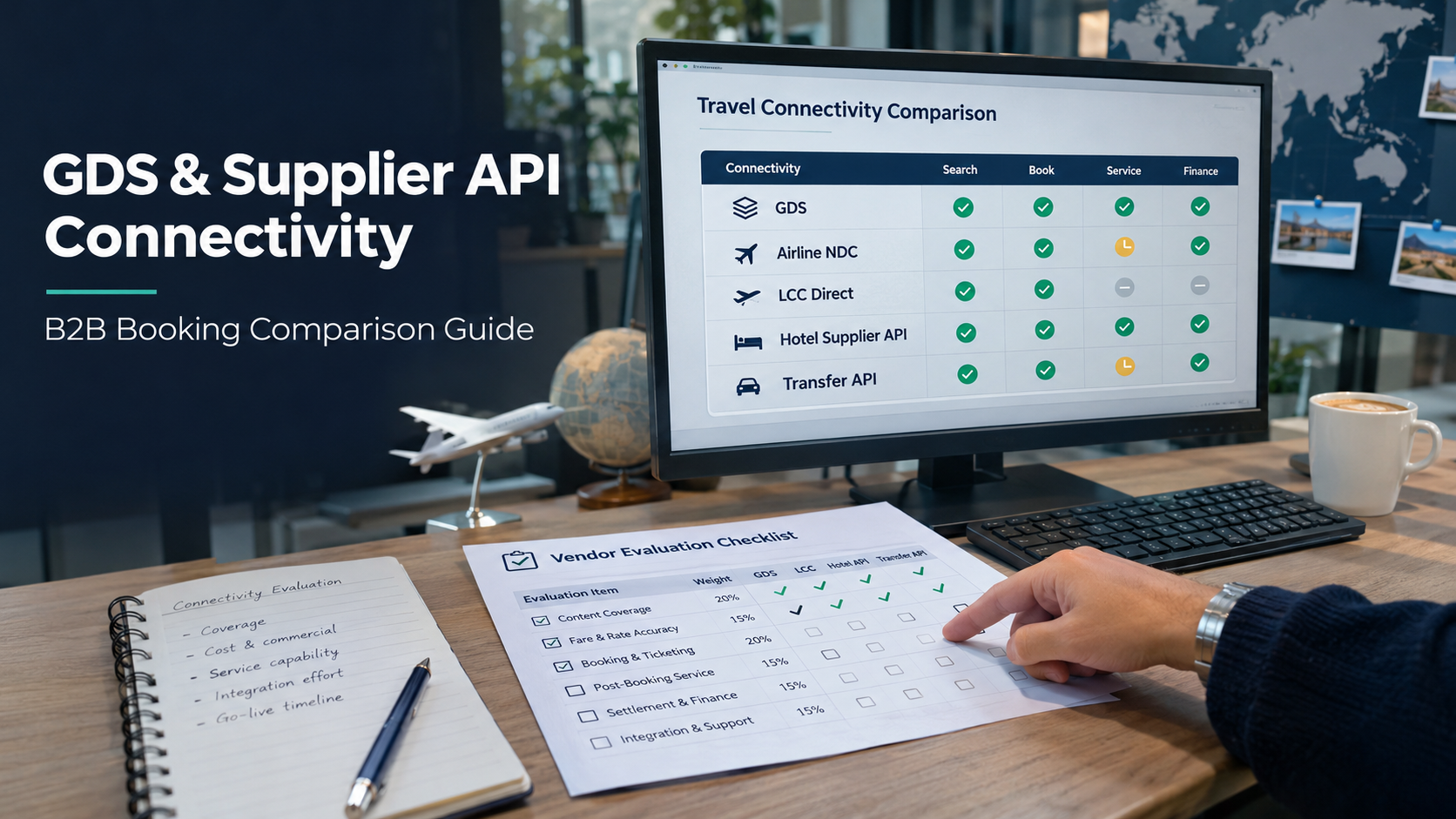
GDS and supplier API connectivity can look impressive in a sales presentation and still fail during everyday B2B booking. A vendor may advertise hundreds of airlines, hotels and transfer providers, but that headline says little about your actual fares, contracted rates, booking reliability, ticketing permissions or post-booking service.
The right comparison starts with a practical question: can each connection support the complete workflow your agency and sub-agents need? That means searching, pricing, booking, ticketing, cancelling, refunding, reconciling and reporting from one operational system.
This guide explains how to compare GDS and supplier API connectivity before selecting a B2B booking platform. It also gives you a scorecard and a live demo script you can use with every shortlisted vendor.
What GDS and Supplier API Connectivity Actually Means
A connection is the technical and commercial route through which a booking platform receives travel inventory and sends transactions back to the source. The source may be a global distribution system, an airline, a hotel wholesaler, an aggregator or another travel supplier.
The four most common connection types are:
- GDS connection: Access to air and, depending on the setup, hotel, car and other content through systems such as Amadeus, Sabre or Travelport.
- Airline NDC connection: An airline retailing connection based on IATA's Offer and Order standards. IATA explains that NDC is a data exchange standard, not a single inventory source or commercial agreement.
- LCC or airline-direct API: A direct or aggregator-mediated route to low-cost carrier and airline content.
- Non-air supplier API: A connection to hotel bedbanks, direct hotel contracts, transfers, activities, insurance or other products.
Most growing agencies need a blended model. A GDS may remain central for ticketing and servicing, while NDC and LCC connections expand airline content. Bedbanks and direct hotel contracts can then improve accommodation coverage and margin. For a deeper air-content explanation, read Travilo's guide to GDS vs NDC vs LCC direct.
GDS vs Supplier API: A Practical Comparison
| Area | GDS connection | Direct or aggregator supplier API |
|---|---|---|
| Typical content | Broad scheduled air content, with additional products depending on the provider and agreement | Airline, hotel, transfer, activity or other supplier-specific inventory |
| Commercial access | Usually requires an agency agreement, PCC or office ID, credentials and ticketing arrangements | Requires a supplier or aggregator contract, credentials, credit terms and market approval |
| Content consistency | More standardized within the selected GDS workflow | Response structure, policies and servicing depth vary by supplier |
| Post-booking | Often strong for ticketing, queues, voids, exchanges and refunds, subject to market and provider access | Can range from complete self-service to offline support only |
| Differentiated content | Depends on airline participation, fares and agency agreements | May provide direct rates, rich content, ancillaries or exclusive inventory |
| Integration effort | Complex certification and workflow setup, but one connection can cover many sources | Each API may require separate mapping, testing, monitoring and support |
Neither option is automatically better. A strong GDS and supplier API connectivity plan depends on your markets, products, accreditation, supplier contracts, target margins and service model.
12 Questions for Comparing GDS and Supplier API Connectivity
1. Which content will our agency actually receive?
Ask for a market-specific inventory list. Do not accept a global supplier count as proof of useful coverage. Confirm airlines, fare types, hotel destinations, currencies, point of sale and any excluded content. If you have negotiated rates or private fares, ask the vendor to demonstrate them with your own credentials.
This matters because an API catalogue does not guarantee identical production content. For example, Amadeus documents differences between its Self-Service and Enterprise access, including content and ticketing limitations. Review the official Amadeus API FAQ to see why the product tier and commercial model must be checked.
2. Who owns the supplier agreement and credentials?
Clarify whether the connection uses your contract, the platform vendor's contract or an aggregator's contract. For a GDS, determine whose PCC or office ID is used. For a hotel supplier, establish who holds the credit line and receives commissions. Ownership affects rates, control, portability and what happens if you change platforms.
3. Does the connection support the complete booking lifecycle?
A search result is not a complete integration. Ask whether the connection supports:
- live search and availability;
- price revalidation before payment;
- booking creation and supplier confirmation;
- ticketing or voucher generation;
- cancellation, void, refund and reissue;
- booking retrieval and synchronization;
- schedule change or supplier notification handling.
Post-booking depth can vary even inside one provider. Travelport's official JSON Air API reference, for example, lists different capabilities for GDS and NDC reservations. Your evaluation must therefore test specific actions, not just provider names.
4. How are results normalized and compared?
A B2B platform may receive similar offers from several sources. It should normalize airports, room names, meal plans, baggage, cancellation policies, taxes and currencies without hiding important differences. Ask how duplicate flights or hotels are identified and how the system chooses which offer to display first.
5. How fast and stable is search?
Request production evidence for average response time, timeout rate and booking failure rate. Ask what happens when one supplier is slow. A good multi-source search should return useful results without allowing one failing API to block the entire page.
6. How does price revalidation work?
Supplier prices can change between search and confirmation. The platform should revalidate fare or rate, clearly show any change and require the user to approve it before booking. It should also prevent duplicate transactions when a confirmation response is delayed.
7. Can we control markup for every B2B level?
For a B2B network, connectivity is only useful when commercial controls sit above it. Test whether you can apply markup by supplier, product, route, airline, hotel, destination, agent group and individual sub-agent. Also check whether taxes, service fees and discounts appear correctly on quotations and invoices.
Travilo's B2B travel portal software is designed to connect inventory with agent hierarchy, markup, wallet and credit controls instead of treating the API as a separate technical layer.
8. How are agent credit and supplier balances protected?
Ask whether the platform checks a sub-agent's available credit before booking and reserves the correct amount during a pending transaction. Confirm what happens when a supplier times out, a booking fails or a refund is approved. The wallet, agent ledger and supplier ledger should remain traceable through every status change.
9. Does every booking post to finance automatically?
A booking should create the required accounting entries without manual retyping. Test sales, supplier cost, tax, markup, service fee, payment, refund and outstanding balance. If air sales are settled through BSP, check how ticket records and billing data reach reconciliation.
This is where a connected travel agency software platform offers more operational value than a standalone booking engine.
10. What monitoring and support are included?
Ask whether the vendor monitors supplier response time, authentication failures, mapping errors and booking exceptions. Define escalation routes and service-level expectations. Your team should be able to see whether an issue belongs to the platform, the supplier or your credentials.
11. What security responsibilities belong to each party?
Document where passenger data, payment data and supplier credentials are stored. Ask about access controls, encryption, audit logs, backup, incident response and credential rotation. If card data enters the workflow, define the payment and PCI DSS boundary before implementation.
12. What will connection, certification and maintenance cost?
Compare the full cost, including setup, supplier certification, transaction fees, support, change requests and future upgrades. A cheap initial connector may become expensive if post-booking actions require manual work. Ask whether the connection is reusable if you add a new B2B brand or market.
A Weighted Vendor Scorecard
Use the same scorecard for every vendor offering GDS and supplier API connectivity. Score each area from 1 to 5, multiply it by the suggested weight and compare totals.
| Evaluation area | Suggested weight | Evidence to request |
|---|---|---|
| Relevant content coverage | 20% | Live results using your market, credentials and test routes |
| Booking and ticketing | 20% | Successful end-to-end test bookings |
| Post-booking service | 15% | Live cancellation, void, refund or change demonstration |
| B2B commercial controls | 15% | Markup, credit, wallet and agent hierarchy tests |
| Finance and reconciliation | 15% | Booking-to-ledger and refund-to-ledger trace |
| Reliability and support | 10% | Performance report, monitoring view and escalation process |
| Implementation and ownership | 5% | Responsibility matrix, timeline and exit terms |
Adjust the weights to match your business. An air consolidator may assign more weight to ticketing and servicing. A hotel-led operator may prioritize rate mapping, cancellation rules and direct contract loading.
The 10-Step Live Demo Test
- Search one high-volume route or destination in your target market.
- Identify the source of each returned offer.
- Open fare rules, baggage or hotel cancellation terms.
- Apply different markup rules for two sub-agent levels.
- Revalidate the selected offer.
- Book using a test agent wallet or credit limit.
- Generate the ticket, voucher and customer invoice.
- Retrieve the booking from the supplier reference.
- Cancel, void or refund it through the supported workflow.
- Trace every financial entry in the agent and supplier ledgers.
Run the same test for at least one GDS booking and one supplier API booking. Record every manual step, delay and exception. This shows whether the vendor's GDS and supplier API connectivity produces a usable B2B booking workflow.
Common Red Flags
Weak GDS and supplier API connectivity often becomes visible through commercial gaps and manual servicing. Watch for these warning signs:
- The vendor quotes a large supplier number but will not demonstrate your required content.
- The connection supports search but sends servicing requests to email.
- Production access depends on credentials or approvals that were never discussed.
- Supplier bookings do not create real-time wallet and ledger entries.
- The platform cannot identify which source produced a booking.
- There is no clear process for timeouts, duplicate bookings or price changes.
- Your agency cannot retain or migrate its contracts, data or credentials.
How Travilo Connects Content With B2B Operations
Travilo brings GDS, NDC, LCC and supplier content into a connected travel agency workflow. Its GDS integration supports Amadeus, Sabre and Galileo connections using the agency's approved credentials and office setup. Connection availability depends on supplier agreements, credentials and market configuration.
The wider platform links search and booking with sub-agent access, markup, wallet, credit control, documents, ledger and reporting. That lets an agency evaluate GDS and supplier API connectivity by the outcome it creates, not by a logo list.
If you are still comparing GDS providers, see Amadeus vs Sabre vs Travelport. If you are evaluating the full platform, use these 12 questions for choosing travel agency software. Both checks help place GDS and supplier API connectivity inside the wider platform decision.
Final Recommendation
Choose connectivity based on complete, proven workflows in your real market. Start with required content, confirm contracts and credentials, then test booking, servicing, commercial controls and finance. A supplier logo is only the beginning.
The best GDS and supplier API connectivity gives your agency useful inventory, reliable transactions and one traceable B2B operation. Ask Travilo for a market-specific demonstration using your target routes, suppliers and agent structure.
Book a Travilo connectivity consultation and compare your required sources against a complete B2B booking workflow.
Frequently Asked Questions
What is the difference between a GDS and a supplier API?
A GDS distributes content from many travel providers through a structured agency workflow. A supplier API connects a platform to a specific airline, hotel wholesaler, transfer provider or aggregator. Many B2B agencies use both to balance coverage, commercial terms and servicing capability.
Does an API connection guarantee access to a supplier's full inventory?
No. Available content can depend on the API product, agency contract, credentials, market, currency, point of sale and supplier approval. Always verify production content using your own commercial setup.
Should a B2B travel agency connect directly to every supplier?
Not always. Direct connections can provide strategic rates or content, but every API adds integration, monitoring and support work. Agencies should connect directly where the commercial value justifies the operational cost and use aggregators where they provide efficient coverage.
What should be tested before a travel API goes live?
Test search, price revalidation, booking, payment, confirmation, cancellation, refund, timeout recovery, duplicate prevention, markup, credit, wallet and ledger posting. Test both successful transactions and expected failure cases.
Can Travilo connect an agency's own GDS credentials?
Travilo supports approved Amadeus, Sabre and Galileo connections using the agency's own credentials and office configuration. Final availability depends on the relevant provider agreement, credentials, approvals and market setup.