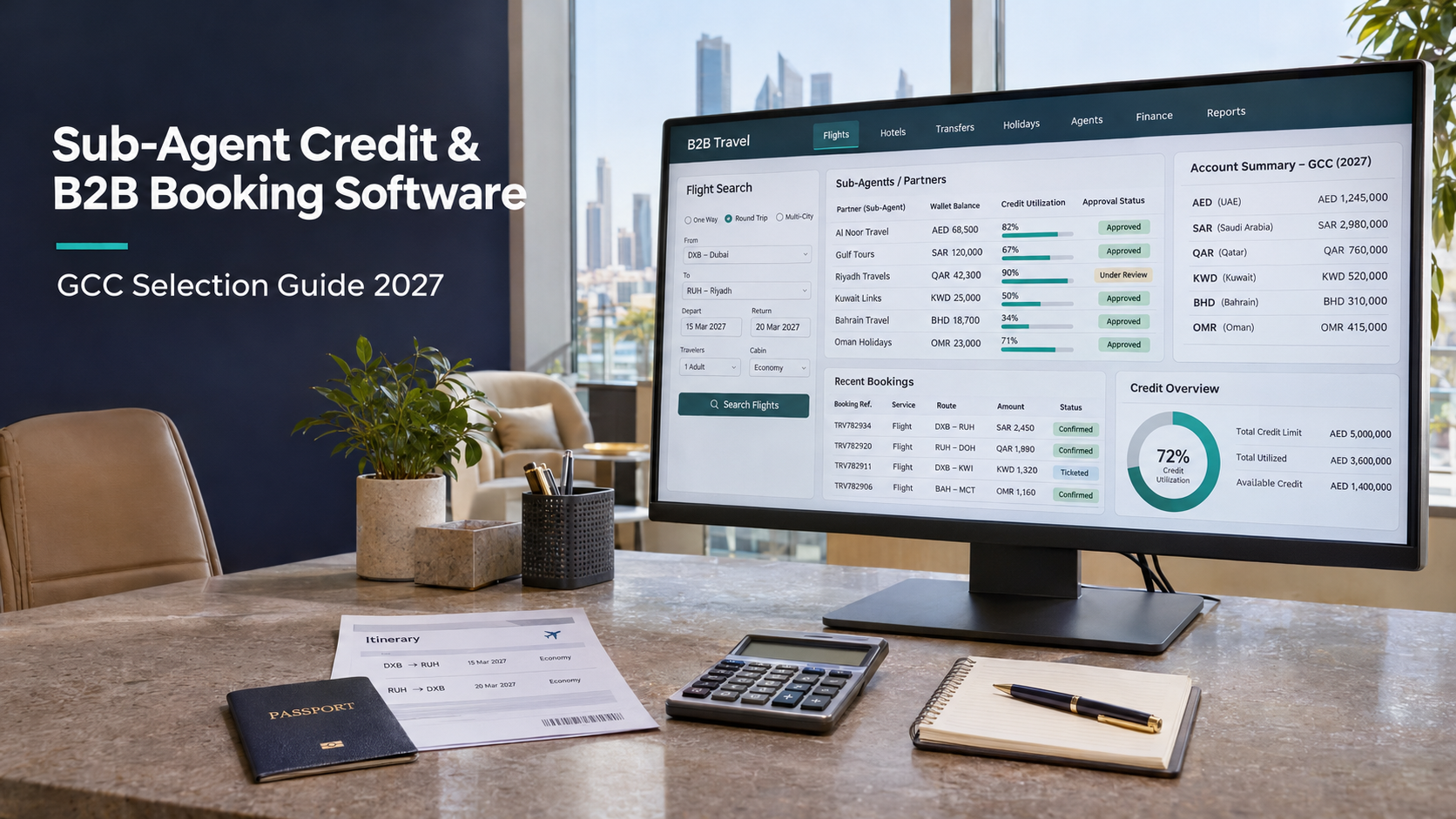
A B2B travel platform can make a GCC agency look ready to scale long before its financial controls are ready. New sub-agents receive logins, searches increase and ticket volume grows. Then one partner exceeds an informal limit, finance cannot confirm the true balance and the master agency remains responsible for supplier settlement.
That is why choosing B2B booking software in 2027 is not only a question of inventory or user experience. The platform must connect every booking to the sub-agent's wallet, approved credit, pricing rules, permissions and ledger. It must help an agency grow distribution without allowing credit exposure to grow invisibly.
This guide explains what GCC travel agencies, consolidators and B2B networks should test before selecting a platform. It focuses on the operational controls that matter across the UAE, Saudi Arabia, Qatar, Kuwait, Bahrain and Oman, while recognizing that tax, payment, employment and data rules differ by country.
Quick Answer: What Should GCC Agencies Look For?
Choose B2B booking software that can:
- Create a clear master-agent and sub-agent hierarchy.
- Separate funded wallet balance from approved credit.
- Check available exposure before booking or ticketing.
- Apply pricing, markup and commission rules by partner group.
- Control search, hold, issue, void, refund and reissue permissions.
- Support relevant currencies, payment methods and local operating needs.
- Connect every booking, deposit, debit and adjustment to a partner ledger.
- Produce finance and operations reports without rebuilding data in spreadsheets.
- Protect card data and support the agency's PCI DSS responsibilities.
- Give both the master agency and sub-agent appropriate self-service visibility.
The best demonstration is not a prepared dashboard. Ask the vendor to run one complete booking from partner creation through settlement, including a failed credit check and a refund.
Why Sub-Agent Credit Is a GCC Software Selection Issue
GCC B2B travel networks often operate at speed. A sub-agent may need to hold or issue a time-sensitive fare while a bank transfer, deposit confirmation or internal approval is still pending. The master agency may also serve partners across multiple cities or countries, each with different sales volumes, currencies and commercial terms.
The risk appears when the booking and financial decision live in different places. Operations sees the PNR. Finance sees a spreadsheet. The sub-agent sends a payment reference through chat. Nobody has one current view of funded balance, approved credit and unsettled exposure.
A useful control model is:
Available booking capacity = approved credit + cleared wallet funds - unsettled exposure
Suppose a Dubai master agency gives a partner an AED 30,000 credit limit. The partner has AED 8,000 in cleared wallet funds and AED 27,000 in unsettled bookings. The remaining capacity is AED 11,000. A new AED 14,000 ticket should be blocked, held for approval or require additional funding.
That decision must happen before the agency becomes financially committed. Travilo's guide to travel agency credit control software explains why wallets, deposits, credit limits and booking access need to remain connected.
The Seven Controls Every B2B Booking Platform Should Have
1. Partner Hierarchy and Account Ownership
The B2B booking software should show the commercial structure clearly:
- master agency;
- branch or business unit;
- agent company;
- sub-agent;
- individual users and roles.
Each booking must retain the company, user, pricing group and responsible account owner. Without that hierarchy, reporting becomes unreliable and access is difficult to control.
The system should also support a defined partner lifecycle: registered, under review, approved, active, suspended and closed. Registration should not automatically create ticketing rights. Use Travilo's B2B travel partner onboarding checklist to structure approval, finance activation and access.
2. Separate Wallets, Deposits and Credit Limits
These records solve different problems:
- Wallet balance represents cleared, funded selling capacity.
- Deposit request records money submitted for verification.
- Credit limit represents additional exposure the master agency has approved.
- Ledger balance explains how bookings, payments, refunds and adjustments changed the position.
Weak software shows one balance without explaining what it contains. Strong B2B booking software separates these values and keeps an audit trail for every change.
3. Real-Time Exposure Checks
A credit report that updates overnight is too late for a live ticketing operation. The B2B booking software should recalculate available credit when a booking is created, modified, ticketed, voided, refunded or reissued.
Ask what the platform does when a partner lacks capacity. Useful options include:
- block ticketing;
- allow a booking hold without issue;
- request a top-up;
- route the transaction for approval;
- restrict action to authorized master-agency staff;
- record the override reason and approver.
Travilo's guide to the seven travel-agent credit-limit controls provides a more detailed risk framework.
4. Pricing and Markup by Agent Group
Sub-agents rarely receive identical commercial terms. The B2B booking software should support pricing by agent tier, product, supplier, route, cabin, market or service type where relevant.
At minimum, test:
- fixed and percentage markups;
- commission rules;
- net and selling-price visibility;
- partner-specific or group pricing;
- manual override permissions;
- change history;
- tax and service-fee treatment configured for the relevant market.
Do not assume one GCC tax setup applies everywhere. Ask the vendor how local configuration, invoices and financial exports are handled in each country where the agency trades.
5. Permission Control Through the Ticket Lifecycle
Searching, holding, issuing and refunding create different levels of financial risk. The B2B booking software should allow the master agency to decide who can:
| Action | Sub-agent user | Sub-agent admin | Master operations | Master finance |
|---|---|---|---|---|
| Search fares | Yes | Yes | Yes | No |
| Create or hold booking | If permitted | Yes | Yes | No |
| Issue ticket | By credit and role | By credit and role | Yes | No |
| Request void, refund or reissue | Yes | Yes | Yes | No |
| Approve refund payout | No | No | Limited | Yes |
| Confirm deposit | No | No | No | Yes |
| Change credit limit | No | No | No | Authorized finance only |
The exact matrix will vary, but the principle is consistent: grant the minimum access needed for each role and keep sensitive financial approvals separate from booking requests.
Travilo's sub-agent management guide shows how hierarchy, credit, markup and access work together across an agent network.
6. Booking-Linked Finance and Settlement
GCC agencies issuing through IATA arrangements need clear control over airline sales and remittance. IATA describes the Billing and Settlement Plan as a standardized framework for sales reporting, remittance and settlement between airlines and accredited agents.
The agency's B2B booking software should therefore retain enough ledger detail to match:
- booking and PNR;
- ticket number;
- supplier or airline;
- sub-agent;
- fare, tax, markup and service fee;
- payment or wallet debit;
- void, refund or reissue adjustment;
- ADM or ACM where applicable;
- amount due and settlement status.
The booking platform does not replace BSPlink or the agency's regulatory responsibilities. It should make reconciliation easier by preserving a traceable record from sub-agent sale to supplier settlement.
7. Security, Audit and Card-Data Controls
A growing agent network creates more users, devices and payment interactions. Evaluate role-based access, authentication, session controls, audit logs, data exports, retention and incident response.
If the agency stores, processes or transmits payment-card data, PCI DSS scope matters. IATA provides specific PCI DSS information for travel agents, while the PCI Security Standards Council publishes the underlying payment-data security standard.
Ask the vendor exactly where card data enters the B2B booking software, whether it is stored, which provider processes it and what documentation supports the vendor's claims. Never accept a general statement that the platform is secure as a substitute for evidence.
GCC Requirements for B2B Booking Software Evaluation
Multi-Currency Operations
An agency may sell or settle in AED, SAR, QAR, KWD, BHD, OMR, USD or other currencies depending on its markets and supplier agreements. Test whether the platform records transaction currency, exchange rate, base currency, conversion differences and ledger impact.
Do not settle for a currency symbol beside a number. Ask how rate changes and refunds are handled when the original sale and later adjustment occur at different rates.
Arabic and English User Experience
If Arabic is required, test the actual portal, invoices, emails and reports. Confirm right-to-left presentation, field alignment, translated system messages and search behavior. A translated landing page does not prove the operational interface is ready.
Local Payment and Banking Workflows
Ask how bank transfers, payment gateways, deposit references, payment approvals and refunds are recorded. The platform should let finance distinguish requested, received, cleared, rejected and reversed payments.
Gateway availability depends on the country, acquiring bank, merchant agreement and provider. Confirm integrations for the legal entity that will actually process the transaction.
Regional Support and Operational Timing
Airline deadlines do not wait for a distant support desk. Ask about support hours, escalation routes, response targets and coverage during weekends or local holidays. Test the support process during the pilot rather than relying only on the sales presentation.
A 100-Point B2B Booking Software Scorecard
Use the same B2B booking software scoring model for every vendor:
| Evaluation area | Weight |
|---|---|
| Sub-agent hierarchy and onboarding | 10 |
| Wallet, deposit and credit controls | 20 |
| Booking, ticketing and servicing workflow | 15 |
| Pricing, markup and commission rules | 10 |
| Ledger, reconciliation and finance reports | 15 |
| Inventory and supplier integration fit | 10 |
| Security, permissions and audit history | 10 |
| GCC localization and multi-currency fit | 5 |
| Implementation, support and total cost | 5 |
| Total | 100 |
Set minimum pass conditions as well. A platform should not win on total score if it cannot block an over-limit ticket, preserve approval history or connect adjustments to the original booking.
The Demo Script Every Vendor Should Complete
Ask each vendor to complete the same scenario live:
- Create a Riyadh sub-agent and two users with different roles.
- Assign a SAR wallet, a controlled credit limit and an agent pricing group.
- Record a deposit request and show the approval process.
- Search for a flight and create a booking.
- Attempt ticketing above the available capacity.
- Show the block or approval workflow.
- Add cleared funds and complete ticketing.
- Process a refund or reissue request.
- Show every resulting wallet and ledger entry.
- Produce the partner balance and master-agency finance reports.
If the vendor skips steps or uses manual corrections behind the scenes, record that in the evaluation. Good B2B booking software should make the transaction traceable without spreadsheets or private chat messages.
How Travilo Fits a GCC B2B Network
Travilo connects bookings, agent management and finance in one B2B booking software platform. Its current travel agency software supports sub-agent access, individual credit limits, wallets, pricing rules, booking permissions, ticket servicing and booking-linked financial records.
For a GCC master agency, the relevant workflow includes:
- onboard and approve the partner;
- assign users and permissions;
- configure wallet, deposit and credit rules;
- apply partner or group pricing;
- search connected fare sources;
- book and issue within allowed capacity;
- track void, refund and reissue requests;
- retain the transaction in the partner ledger;
- review balances and operational reports.
Travilo's connected operations overview explains how partner controls, booking workflows, payments and reporting remain tied to one transaction. Connection availability still depends on supplier agreements, credentials and the agency's market setup, so those items should be confirmed during discovery.
Frequently Asked Questions
What Is B2B Booking Software for Travel Agencies?
B2B booking software lets a master travel agency or consolidator distribute travel inventory to partner agencies and sub-agents. It normally includes partner accounts, pricing rules, booking permissions, wallets, credit limits, ticketing workflows and financial reporting.
How Should a GCC Agency Control Sub-Agent Credit?
Separate cleared wallet funds from approved credit, calculate unsettled exposure in real time and check available capacity before ticketing. Over-limit transactions should be blocked or routed to an authorized approver, with the reason and decision retained in an audit history.
Is an Agent Wallet the Same as a Credit Limit?
No. A wallet represents funded value available to the partner. A credit limit represents additional exposure the master agency has agreed to accept. The platform should show both separately and combine them only when calculating available booking capacity.
Which Currencies Should GCC Travel Software Support?
The required currencies depend on where the agency sells, receives payment and settles with suppliers. Many GCC operations need combinations of AED, SAR, QAR, KWD, BHD, OMR and USD. Buyers should test transaction currency, exchange rates, refunds and ledger reporting rather than checking only the list of supported symbols.
What Should a Travel Agency Test During a Software Demo?
Test a complete partner journey: onboarding, roles, wallet setup, deposit approval, credit limit, fare search, over-limit ticketing, successful issue, refund or reissue and final ledger reporting. Use the same scenario with every vendor.
Select for Control Before You Select for Scale
A growing sub-agent network can generate valuable distribution across the GCC, but every booking also creates operational and financial responsibility. The right B2B booking software keeps partner access, pricing, credit exposure, ticketing and finance connected from the first search to final settlement.
Prioritize real-time credit enforcement, clear ledgers, controlled permissions and a complete audit trail. Then evaluate inventory, localization, integrations and commercial terms. To see how Travilo supports this workflow, explore the platform and ask the team to demonstrate your own sub-agent credit scenario from start to finish.