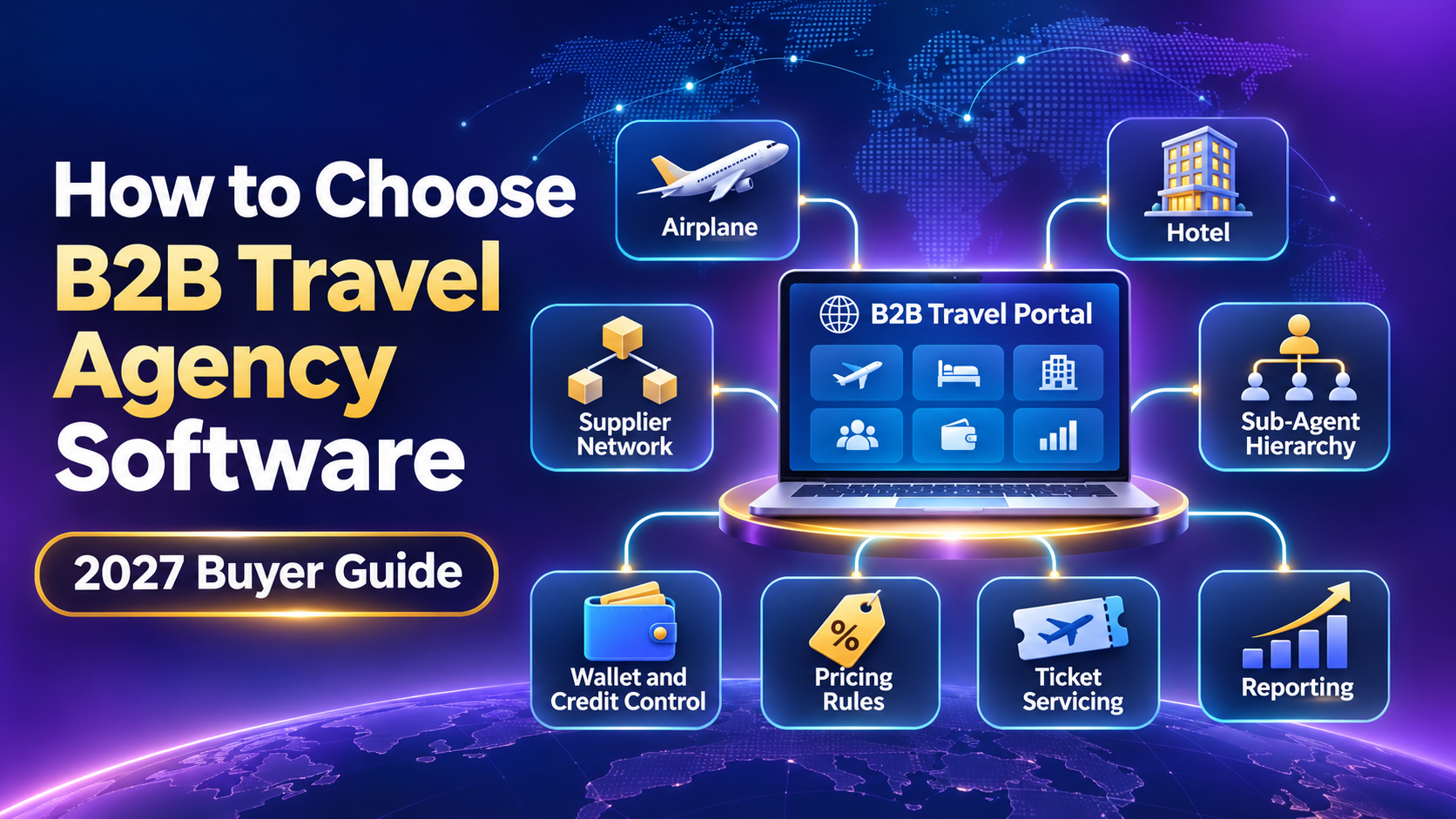
Choosing B2B travel agency software in 2027 requires more than comparing flight-search screens. A strong platform must control the complete relationship between a master agency and its selling partners: who can access inventory, which price each agent sees, how much credit is available, who may issue a ticket and how every booking changes the ledger.
The wrong system can still produce bookings while creating hidden operational debt. Agents chase balances through WhatsApp, finance rebuilds transactions in spreadsheets and refund requests lose their connection to the original ticket.
The right system keeps supplier content, partner rules, booking operations and money inside one traceable workflow. This guide explains the 12 capabilities to evaluate, the demo scenarios to test and the red flags to avoid.
Quick Answer: How Do You Choose B2B Travel Agency Software?
Evaluate B2B travel agency software across these 12 areas:
- Agent and sub-agent hierarchy
- Supplier and content connectivity
- Search, booking and ticketing workflow
- Markup, commission and pricing control
- Wallets, deposits and credit limits
- Roles, permissions and approvals
- Refund, void and reissue servicing
- Agent ledgers and travel accounting
- Branding, currency and market readiness
- Security and payment-data handling
- Reporting and audit trails
- Implementation, support and total cost
Shortlist platforms only after defining your operating model. Then ask every vendor to demonstrate the same real booking, credit and servicing scenarios.
What Is B2B Travel Agency Software?
B2B travel agency software is an operating platform that lets a master agency, consolidator or host agency distribute travel products through partner agencies and sub-agents.
Each partner may have its own users, pricing, commission, wallet, credit limit and booking permissions. The master agency remains responsible for supplier relationships, financial exposure, operational controls and the services delivered through its network.
A basic booking engine searches and reserves travel. A B2B platform adds partner governance around that transaction. It should answer:
- Which agent created the booking?
- Which supplier and commercial rule produced the price?
- Was the booking funded by wallet, deposit or credit?
- Who approved ticket issuance?
- What does the partner currently owe?
- How will a refund or reissue change the balance?
Travilo’s guide to sub-agent management explains how hierarchy, pricing, access and ledgers work across a B2B network.
What Changes in a 2027 Software Evaluation?
Supplier fragmentation, digital payments and larger partner networks make four areas especially important.
Complete Content Matters More Than a Supplier Logo
A platform may advertise GDS, NDC, low-cost airline and hotel connections, but availability depends on supplier approval, credentials, commercial agreements and market setup. Ask which sources are live for your entity and whether the system supports servicing after sale, not only search.
Financial Control Must Happen Before Ticketing
A monthly credit report is too late. The system should calculate available funding when an agent tries to book or issue. Wallet balance, cleared deposits and approved credit must remain separate.
Post-Booking Service Must Stay Connected
Search is only the first step. Schedule changes, voids, refunds, reissues and supplier credits should remain attached to the original booking and financial trail.
Security Must Cover the Whole Payment Workflow
Travel agencies handle sensitive payment information. IATA’s PCI DSS guidance for travel agents explains the importance of protecting cardholder data and requires accredited agents using relevant card-payment processes to maintain appropriate compliance. Confirm obligations with qualified security and legal advisers.
The 12 Capabilities to Evaluate
1. Agent and Sub-Agent Hierarchy
The platform should connect every booking to a named user, partner account and master agency. It should support different partner statuses, such as pending, active, on hold and suspended.
Ask the vendor to create a new partner, add two users and show exactly what each can see. Shared logins and flat user lists make accountability difficult.
2. Supplier and Content Connectivity
Confirm which GDS, NDC, airline, hotel, transfer, insurance or other supplier sources are available for your markets. Check whether connections require separate contracts, credentials, certification or fees.
Test one complete transaction per source:
Search → Revalidate → Book → Pay → Ticket or Confirm → Service → Report
A source that returns attractive fares but cannot support changes or refunds may create expensive manual work.
3. Search, Booking and Ticketing Workflow
Good B2B travel agency software should preserve the supplier response, passenger details, price, PNR or order reference, ticket status and responsible agent.
Check how the platform handles expired fares, failed bookings, duplicate PNRs, queues, ticket time limits and authorised PNR import. The operating record should remain understandable after the original agent is unavailable.
4. Markup, Commission and Pricing Control
Partners rarely receive one universal price. The system should apply pricing by agent group, product, supplier, route, cabin, value or other approved commercial rule.
Ask to see:
- Fixed and percentage markups
- Minimum and maximum limits
- Commission tiers
- Rule priority when several conditions match
- Restricted overrides with reasons
- An audit trail showing the applied rule
Pricing should remain explainable to operations and finance, not hidden inside one selling total.
5. Wallets, Deposits and Credit Limits
A wallet represents funded selling capacity. A deposit adds cleared value. A credit limit permits approved exposure beyond available funds. Combining them into one balance hides risk.
A useful control is:
Available capacity = wallet balance + approved available credit - unsettled exposure
The system should block, hold or route a booking for approval when capacity is insufficient. Travilo’s guide to travel agency credit control software provides a practical test workflow.
6. Roles, Permissions and Approvals
Apply least access according to the user’s job. Searching, holding, ticketing, approving refunds, changing credit and editing pricing should be separate permissions.
Test separation of duties. A user who requests a credit increase should not approve it. A sub-agent may request a refund, while master-agency finance authorises the payout.
7. Refund, Void and Reissue Servicing
Evaluate what happens after ticketing. The system should keep requests, approvals, penalties, additional collections, supplier credits and customer payouts connected to the original transaction.
Ask the vendor to demonstrate one void, one partial refund and one reissue with a fare difference. If the workflow leaves the platform, determine how the result returns to the booking and ledger.
8. Agent Ledgers and Travel Accounting
Each partner needs a running ledger showing bookings, tickets, deposits, payments, commissions, fees, refunds and adjustments. Finance should be able to trace every entry to the transaction that created it.
For agencies using airline settlement processes, IATA describes BSP as a system that simplifies financial interactions between agents and airlines. The platform should preserve the references needed for sales, refund and settlement reconciliation.
9. Branding, Currency and Market Readiness
Check whether the portal supports your brand, domain, languages, currencies, time zones, tax presentation and regional payment methods. Multi-currency support should preserve supplier currency, selling currency, exchange rate and settlement value.
Do not accept “multi-country ready” without testing your actual UAE, Pakistan, Sri Lanka or other target-market workflow.
10. Security and Payment-Data Handling
Ask where data is hosted, how it is encrypted, how administrators authenticate and how access is logged. Review backup, recovery, incident-response and retention practices.
Do not assume that buying software makes the agency compliant. Clarify which party stores, processes or transmits card information and which responsibilities remain with the agency, gateway and supplier.
11. Reporting and Audit Trails
Management should be able to review sales, margin, partner balances, overdue exposure, wallet activity, refunds, overrides and supplier performance without rebuilding data in spreadsheets.
Every sensitive change should record the user, time, previous value, new value and reason. Reports should be exportable and definitions should remain consistent.
12. Implementation, Support and Total Cost
Ask for a written scope covering modules, integrations, branding, migration, testing, training, support, hosting and custom work. Separate one-time implementation from monthly platform cost, supplier fees, payment-gateway charges and future changes.
The cheapest quote can become the most expensive option if supplier onboarding, finance configuration or post-launch support is excluded.
B2B Travel Agency Software Evaluation Scorecard
When comparing B2B travel agency software, score each shortlisted platform from 1 to 5 in every area.
| Evaluation area | Weight | Key test |
|---|---|---|
| Agent hierarchy and access | 15% | Can different partners and users have different rights? |
| Supplier content and servicing | 15% | Can the platform complete and service real bookings? |
| Pricing and commission | 10% | Are commercial rules explainable and auditable? |
| Wallets and credit control | 15% | Does risk stop before confirmation or ticketing? |
| Booking and post-ticket workflow | 15% | Do refunds and reissues stay connected? |
| Finance and reporting | 10% | Can every balance trace back to a transaction? |
| Security and governance | 10% | Are access, payment data and audit controls clear? |
| Implementation and support | 10% | Is the launch scope realistic and complete? |
Do not let an impressive search interface compensate for weak credit, servicing or finance controls.
Three Demo Scenarios Every Vendor Should Complete
Scenario 1: Onboard and Activate a New Sub-Agent
Create the partner, verify company details, add users, assign a pricing group, configure a wallet or credit limit and restrict ticketing. Then show the approval and audit history.
Use Travilo’s B2B partner onboarding checklist to prepare the test.
Scenario 2: Block an Unfunded Booking
Have the agent search a live itinerary and attempt a booking above available capacity. The platform should calculate exposure, stop or route the transaction and show the reason to authorised users.
Scenario 3: Process a Reissue and Reconcile the Ledger
Change a ticket, collect the fare difference and fee, update the supplier obligation and show the revised partner balance. This reveals whether booking, servicing and finance are genuinely connected.
Red Flags When Choosing a Platform
Be cautious if a vendor:
- Demonstrates only search and booking
- Cannot show agent-level credit enforcement
- Uses shared accounts or broad administrator access
- Stores pricing logic outside the transaction record
- Requires spreadsheets for partner balances
- Cannot trace refunds to the original ticket
- Promises every supplier connection without checking credentials
- Hides integration, hosting or customisation costs
- Has no realistic implementation and testing plan
How Travilo Fits the Evaluation
Travilo is built around keeping bookings, agents, payments and post-ticket work connected. Its current B2B workflow includes partner hierarchy, role-based access, wallets, deposits, credit limits, pricing rules and operational reporting.
Supplier and payment connections are configured according to commercial agreements, credentials and implementation scope. That is the right question for any vendor: not whether a logo appears on an integration page, but whether the approved connection supports the workflow your agency needs.
Travilo currently publishes a setup investment and flat monthly platform model rather than a per-ticket fee or revenue share. Pricing, integrations and custom work should always be confirmed in the current written proposal.
Review Travilo’s live travel agency software capabilities and connected operating model. Bring a real agent, credit or refund scenario to the demonstration instead of requesting a generic feature tour.
Frequently Asked Questions
What is the most important feature in B2B travel agency software?
The most important capability is connected control. Supplier content, agent identity, price, funding, booking status and ledger activity should remain linked. A strong search engine cannot compensate for disconnected finance and servicing.
What is the difference between B2B travel software and a booking engine?
A booking engine searches and reserves travel. B2B travel software adds partner onboarding, agent hierarchy, pricing, commissions, wallets, credit limits, permissions, ledgers and operational reporting around the booking.
Should B2B travel software include credit limits?
Yes, if the agency allows partners to transact beyond cleared deposits. The system should calculate available exposure before booking or ticketing and block or route transactions that exceed the approved limit.
How should an agency test supplier integrations?
Run a complete scenario for each important source: search, revalidate, book, pay, confirm or ticket, change, cancel or refund and report. Confirm the required contracts, credentials and supplier approvals.
How long does B2B travel software implementation take?
Timing depends on modules, supplier connections, payment setup, branding, migration, testing and custom requirements. Ask for a written project plan with owners, dependencies, acceptance criteria and training before signing.
Choose the Workflow, Not the Feature List
Learning how to choose B2B travel agency software means following a booking beyond search. The platform must keep the agent, price, funding, ticket, service request and financial result connected.
Define your operating model first. Score every vendor against the same criteria. Test real exceptions, not perfect demo bookings. The best choice is the platform that lets the agency grow partner sales while preserving control of risk, margin and service quality.