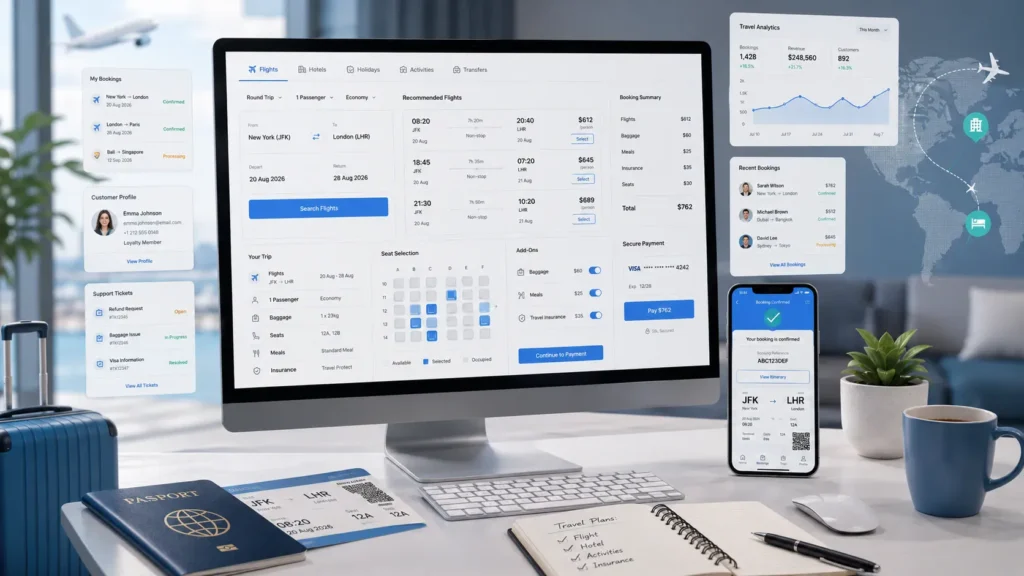
Running a B2C travel business means serving travelers directly. Your customer may discover a destination, search for a flight, compare fares, select extras, make a payment, receive a booking confirmation, and later ask for support. The travel agency software behind your website needs to connect those steps instead of forcing your team to manage them across disconnected systems.
This matters even more as airline distribution moves toward richer digital retailing. IATA describes modern airline retailing as a shift toward more personalized, efficient, and seamless customer experiences across channels. Its New Distribution Capability, or NDC, is designed to improve communication between airlines and travel sellers while supporting richer content and more transparent shopping experiences.
So, when you evaluate travel agency software for B2C travel businesses, the question should not simply be, “Can customers book a flight?” A better question is, “Can this system support the complete customer journey before, during, and after the booking?”
What Is B2C Travel Agency Software?
B2C travel agency software is the technology a travel business uses to sell travel products directly to individual travelers through a website or other customer-facing channel.
Depending on the platform, those products may include flights, hotels, packages, insurance, tours, car rentals, and additional travel services. A complete platform can also connect customer accounts, booking management, payment processing, supplier integrations, reporting, and customer support.
The TRAVILO specification follows this broader OTA model. Its stated purpose is to support flight, hotel, and ancillary bookings for both B2B and B2C markets through booking engines, supplier APIs, payment integrations, reporting, and customer-facing interfaces.
For a B2C travel business, this integrated approach can be more useful than thinking about a booking engine as a standalone website feature.
1. Real-Time Search and Booking Should Be the Foundation
The booking experience starts with search.
For flight sales, customers should be able to enter their origin, destination, travel dates, passenger information, and preferred travel class. Common trip structures include one-way, round-trip, and multi-city searches.
The supplied TRAVILO requirements describe these search flows in detail, including origin and destination selection, journey and return dates, adult, child and infant passenger information, travel class, and one-way, round-trip, and multi-city journeys. Its requirements also describe filtering results by factors such as price, schedules, airlines, stops, and different flight-selection options.
For a B2C website, evaluate how easily a traveler can move from search to selection. The interface should help customers understand what they are buying rather than simply return a long list of fares.
2. Supplier Connectivity Matters as Much as the Website
A polished booking interface is only useful when the underlying travel content is reliable.
Travel software normally needs connectivity to airlines, suppliers, booking systems, or APIs that can provide inventory and booking information. IATA’s NDC standard is specifically intended to improve communication between airlines and travel agents and enable richer airline offers through modern distribution technology.
When comparing platforms, ask:
- Which airline, GDS, NDC, hotel, or other supplier connections are currently supported?
- Is availability retrieved in real time?
- How are fare changes handled before confirmation?
- What happens when a supplier rejects a booking?
- Can new suppliers or APIs be integrated later?
TRAVILO’s BRS identifies supplier management, third-party supplier integration, airline ticketing integration, and a dynamic booking engine for availability, booking, and confirmation as part of the platform scope.
These are important capabilities, but the exact production supplier coverage should always be verified before selecting any platform.
3. Ancillary Sales Can Make the Booking Experience More Complete
A traveler may want more than the base ticket.
Seat selection, extra baggage, meals, and travel insurance are examples of services that can become part of the booking journey. IATA’s work on modern airline retailing and NDC is partly focused on giving travel sellers access to richer airline content and offers rather than limiting shopping to a basic fare display.
TRAVILO’s requirements provide a detailed ancillary workflow covering:
- Meal selection
- Seat selection
- Additional baggage
- Travel insurance
- Per-passenger and per-segment selections
- Ancillary pricing
- Cart updates
- Review before payment
- Post-booking and post-ticketing ancillary handling
The specification also states that ancillary eligibility and pricing should be checked against supplier rules, airline configuration, passenger information, route details, and booking status.
For a B2C business, the important principle is relevance. Extras should help customers complete their trip, with prices and conditions clearly visible before payment.
4. Payments Need Convenience and Security
Payment is one of the most sensitive parts of an online travel business.
If a platform handles payment card information, payment security should be considered from the beginning. The PCI Security Standards Council states that PCI DSS provides baseline technical and operational requirements designed to protect payment account data and applies to organizations that store, process, transmit, or can affect the security of cardholder data.
Before choosing B2C travel software, ask which payment gateways are supported, which currencies can be handled, how payment failures are managed, and what payment information passes through the travel platform itself.
TRAVILO’s product specification includes payment integration as a core module and describes deposit management, online payment methods, transaction history, financial ledgers, charges, approval amounts, and payment-related reporting. Many of these documented workflows are specifically described for B2B partners, so a B2C operator should confirm which payment functions are available on the customer-facing side.
5. Customer Accounts Should Reduce Repetitive Work
Customers commonly need access to booking information after checkout.
Useful account functionality can include traveler information, booking history, ticket details, profile management, password management, and access to support. TRAVILO’s overall scope identifies customer accounts for managing personal bookings, viewing history, and accessing support, while its detailed requirements include traveler records and user-management functions.
Authentication also deserves attention. NIST’s current Digital Identity Guidelines cover identity proofing, authentication, federation, authenticators, and related identity-management processes. They provide a useful security reference when evaluating how online accounts are protected.
TRAVILO’s documented login process includes password controls, password reset functionality, OTP-based authentication, and Google login functionality for its portal workflows.
6. Post-Booking Management Is Part of the Customer Experience
A booking is not the end of a travel transaction.
Customers may need a booking confirmation, ticket details, schedule information, cancellation assistance, refund support, or help with a booking problem.
The TRAVILO BRS describes booking statuses including On Hold, Failed Booking, Confirmed Ticket, and In Progress. It also references ticket-management workflows for void, refund, reissue, booking details, and ticket issuance.
When comparing platforms, do not evaluate only the search page. Ask how your operations team handles a booking after payment and what information the customer can access without contacting an employee.
A system that connects booking records and support requests can give agents more context when a problem occurs.
7. Reporting Should Help You Understand What Is Happening
Travel agency owners need operational visibility, not just booking notifications.
TRAVILO’s dashboard requirements include total bookings, ticket counts, sales figures, airline performance, booking trends, payment information, calendar-based booking analytics, and time filters. Its Payment Ledger is designed to record transaction movements and running balances, while other finance modules cover deposits and payment activity.
For a B2C operator, determine which metrics are available specifically for customer-facing sales. Useful questions include which products are being booked, which suppliers generate sales, how bookings change over time, how many transactions fail, and what revenue is associated with different services.
The exact reporting capabilities should be checked against your own business KPIs before implementation.
How to Choose Travel Agency Software for a B2C Business
Do not choose a platform from the feature list alone.
Work through your actual customer journey from beginning to end:
- Search for a realistic itinerary.
- Compare the results a traveler would see.
- Check fare and baggage information.
- Add passengers and optional services.
- Review the complete price.
- Test the payment flow.
- Examine the confirmation and ticket experience.
- Check how cancellations, refunds, or booking problems are handled.
- Review the customer account.
- Review the operational and financial reporting available to your team.
Also verify supplier connectivity, API documentation, payment-security responsibilities, authentication controls, implementation requirements, support responsibilities, and any features that are still planned rather than currently available. IATA, PCI DSS, and NIST provide useful primary references for airline distribution, payment security, and digital authentication respectively.
Common Mistakes to Avoid
One mistake is choosing software primarily because the front-end design looks modern. The booking interface is important, but supplier connectivity, payment processing, booking management, and post-booking operations determine whether the complete system works for your business.
Another mistake is assuming every item on a product roadmap is already available. The TRAVILO BRS, for example, describes a Phase 1 web-based OTA platform and identifies mobile application development as Phase 2. Buyers should therefore confirm the production status of individual capabilities before relying on them.
Finally, separate B2B and B2C requirements. TRAVILO is defined as supporting both markets, but much of the supplied BRS documents B2B partner workflows in greater detail. A B2C travel company should confirm exactly which search, account, payment, booking-management, ancillary, and support capabilities are available directly to end customers.
Final Step: How TRAVILO Can Help Grow Your Online Travel Business
Based on the supplied Business Requirement Specification, TRAVILO is being designed as a broader OTA platform rather than only a flight-search tool.
Its documented scope combines a web-based booking platform with supplier integrations, a booking engine, payment functionality, reporting, customer support, and user management. The specification covers flights, hotels, ancillary services and, in its broader platform description, services such as tours and car rentals. It is intended to serve both B2B and B2C markets.
For an online travel business, that architecture can support several parts of the commercial journey in one environment: customers search for travel, bookings are processed through connected inventory, additional services can be attached, payments are recorded, booking information is managed, and support can reference existing booking or ticket records.
The BRS also describes operational features such as dashboards, booking analytics, traveler records, financial ledgers, support tickets, company settings, branches, staff access, and bank-account management. Those capabilities can be relevant as a travel operation becomes more complex, although several are documented specifically around B2B agency operations.
If your goal is to grow direct online sales, the next step should be to map your required B2C customer journey against TRAVILO’s currently implemented modules. Confirm supplier integrations, customer-facing booking capabilities, supported payment methods, ancillary availability, post-booking workflows, reporting, and the delivery status of planned functionality before implementation.
Conclusion
The best travel agency software for B2C travel businesses is not simply the platform with the longest feature list. It is the one that connects the parts of your customer journey that matter to your specific business.
Start with reliable travel inventory and an understandable search experience. Then evaluate booking, ancillaries, payments, customer accounts, ticket management, support, security, and reporting as one connected workflow.
TRAVILO’s specification shows an OTA platform designed around many of these functions for both B2B and B2C operations. The final buying decision should be based on which documented capabilities are currently available, which supplier and payment integrations match your market, and how smoothly the platform supports your real customer journey.