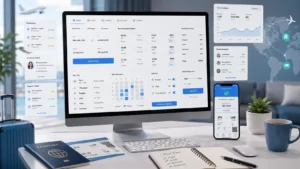
draft an email — and by the time you hit send, the price has moved. A b2b travel system replaces that scramble with a single platform built for how agencies actually work. Instead of hopping between consumer booking sites, spreadsheets, and email threads, you search, book, ticket, and manage traveller data in one place.
This guide explains what a b2b travel system does, how it differs from the tools travelers use themselves, and what to look for when choosing travel agency software.
The Problem with Managing Bookings the Manual Way
Running bookings through spreadsheets and email threads works — until it doesn’t. A fare changes while you type an email. Traveller data lives in half a dozen files, each slightly out of date. Deposits and invoices get tracked across a chain of replies, and when a client asks “how much have I paid so far?” you spend ten minutes digging.
None of this is unusual. It’s just what happens when the tools weren’t built for the job. The cost shows up in missed sales, double entry, and the occasional deposit that slips through the cracks. A b2b travel system exists to remove exactly these failure points.
What Should a B2B Travel System Include?
The core of any solid travel agency software is a set of non-negotiables. When you evaluate platforms, check that these capabilities are standard:
- Multi-supplier search — one query covers airlines, hotels, car rental providers, and tour operators
- Booking and ticketing — issue tickets directly from the platform, not through a separate portal
- Traveller profiles — stored passenger details that carry across bookings
- Payment and deposit tracking — a clear view of what each client has paid and what’s outstanding
- Invoice generation — send a professional invoice in a couple of clicks
If a platform sits behind a paywall for any of these, keep looking.
Beyond Bookings: Payments, Deposits, and Traveller Management
The features that separate good travel agency management software from a simple search tool are financial. A repeat client should not reintroduce their passport number and phone number every time they book. Their profile should load with one click, their payment history visible alongside it.
Deposit workflows matter just as much. A client books a holiday in January for a June departure — you need to track the deposit now and the balance later. The right system shows the full payment schedule at a glance, so nothing gets missed in the gap between booking and departure.
How B2B Travel Software Differs from Consumer OTA Tools
This is the question buyers ask most often. Consumer sites like Booking.com or Expedia are built for travelers — the person taking the trip. A b2b travel system is built for the agent — the person selling the trip.
| Capability | Consumer OTA | B2B travel system |
| Fares | Published retail prices only | Net fares and markup control |
| Suppliers | A curated selection | Multi-supplier access via GDS and APIs |
| Traveller data | Stored per transaction, login required | Persistent profiles shared across bookings |
| Payments | Simple card checkout | Deposit schedules, invoices, payment tracking |
| Markup | None — fixed prices | Configurable markup on every product |
The difference is structural. Online travel agency software is a tool for selling travel at scale; a consumer site is a storefront for end customers.
Real-Time Booking Engine with Live Availability
A booking engine is only useful if the data behind it is live. The moment a fare changes, an inventory closes, or a flight fills up, the system must reflect it. Consumer sites often lag on this — you’ve likely seen a traveler quote a price that no longer exists.
A b2b travel booking engine pulls live availability straight from suppliers, so what you see is what your client can actually book. No more selling a fare that vanished an hour ago.
GDS and Supplier API Integration
GDS stands for Global Distribution System — the networks that connect travel sellers to airline and hotel inventory worldwide. When travel agency software integrates with a GDS and supplier APIs, you get one connection to a massive pool of real-time content.
The practical effect: you search a single platform instead of logging into multiple supplier portals. A global distribution system for travel agencies is the plumbing — your b2b system is the interface that makes it usable.
Built for Travel Agents, Not Just Travelers
Here’s the day-to-day reality of using a travel booking platform for travel agents. You log in, search for the client’s dates, and see live options from every supplier at once. You book the flight, add the hotel, and reserve a car — all in the same session. The ticket issues, the traveller profile saves, and the deposit invoice goes out in minutes.
It’s one connected path, not a chain of separate tools. Your client gets a faster answer, and you get a record of everything in one place.
One Booking System for Flights, Hotels, Cars, and Tours
Most agencies sell more than flights. Yet many run separate portals for each product type — an airline dashboard here, a hotel extranet there, a tour operator login around the corner. A travel agent booking system consolidates all of it into a single interface.
One search, one booking flow, one place to manage everything. Your staff learns one system instead of five.
Scaling from a Few Bookings to a Full Bookings Pipeline
If you’re a small agency, the pitch for travel management software for small agencies is simple. Consider the before and after.
| Scenario | Before | After |
| Client requests a June holiday quote | Check three sites, draft email, hope the fare holds | One search, one reply, fare locked in live |
| Repeat client calls for a booking | Re-enter passport, phone, and preferences | Load saved profile, book in two clicks |
| Client asks about outstanding balance | Scroll through email threads to piece it together | Open the booking, see the payment schedule |
It doesn’t just automate tasks. It removes the errors that manual handling introduces, so a deposit tracked in an email thread isn’t lost when someone changes their inbox.
What to Look for When Choosing B2B Travel Software
When you evaluate vendors, use this five-point checklist:
- Supplier coverage — how many airlines, hotels, and car providers can you actually book? Ask for the number, not a vague promise.
- Real-time data — test the search speed yourself and check whether availability updates instantly.
- Payment handling — can you take deposits, track balances, and issue invoices without a separate accounting tool?
- Ease of use — would your staff be productive within a week of training?
- Support — what happens when a booking fails at 6 p.m.? Ask about response times and channels.
A vendor’s demo will always look polished. Run these tests against your own realistic booking scenarios before you commit. The best travel software for travel agencies depends on your product mix — ask each supplier which agencies in your vertical already use their platform.
Ready to see how a b2b travel system handles your agency’s bookings? Book a demo with Travilo and see live availability, ticketing, and payment management in action.