
Why Indonesian Travel Agencies Are Going Digital Faster Than Ever
The travel industry in Indonesia is undergoing a seismic transformation. And it is happening at a pace that is difficult to ignore. A confluence of factors – soaring smartphone penetration, a rapidly expanding middle class, and a post-pandemic surge in domestic and international travel demand – has created a perfect environment for digital adoption. Travel agencies that once relied on telephone reservations, printed itineraries, and handwritten ledgers are now racing to modernise their operations.
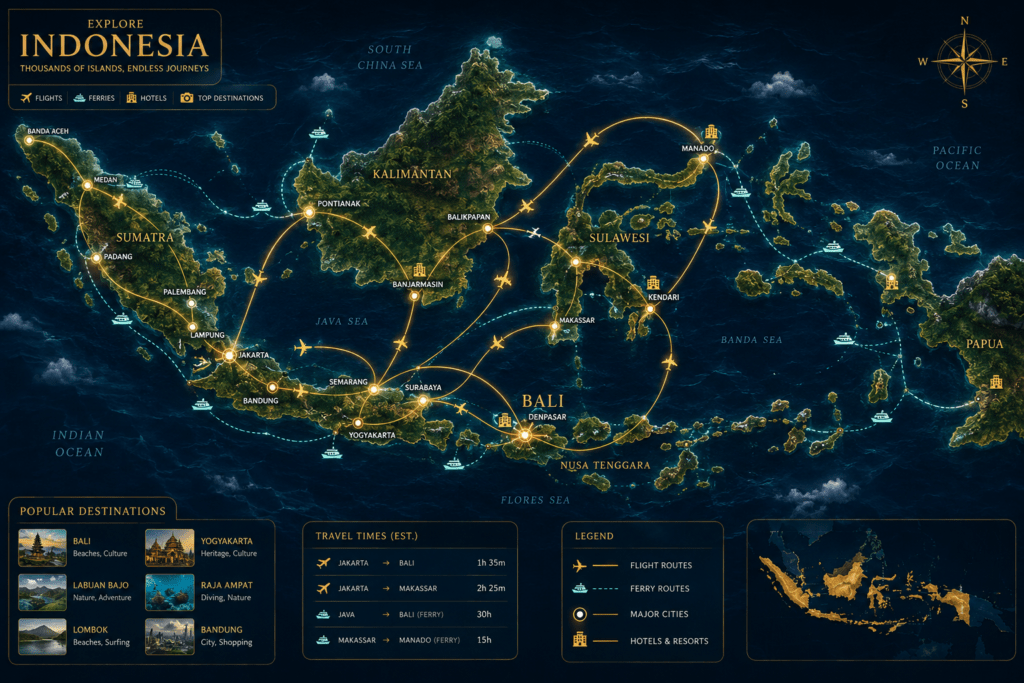
Indonesia is the fourth most populous country in the world, with over 270 million people spread across more than 17,000 islands. The sheer logistical complexity of connecting travellers across this archipelago means that speed, accuracy, and automation are no longer optional – they are existential requirements. Agencies that fail to adapt are haemorrhaging clients to online booking platforms and nimble digital-first competitors.
The numbers speak for themselves. Indonesia’s digital travel market has been growing at double digits annually, with B2B travel technology adoption accelerating sharply since 2022. The message is clear: digital or die.
The Unique Challenges of Running a Travel Agency in Indonesia
What Makes the Indonesian Travel Market Different from the Rest of Southeast Asia
Indonesia is not Thailand. It is not Singapore. It occupies a category entirely its own. The geographic fragmentation alone creates complexities that most regional travel platforms are simply not built to handle. Domestic air routes are labyrinthine, interisland ferry connections are critical, and the mix of budget, mid-range, and premium travellers within a single itinerary is commonplace.
Cultural diversity also plays a decisive role. Travel preferences vary enormously between Javanese, Balinese, Sumatran, and Sulawesi travellers. Religious considerations – particularly for the world’s largest Muslim-majority population – influence everything from airline meal preferences to insurance eligibility windows. Any software that ignores this nuance will fail in the field.
Beyond culture, Indonesia’s financial infrastructure adds another layer of complexity. Not every traveller has access to international credit cards. Mobile banking via platforms like GoPay, OVO, Dana, and BCA Mobile is the norm, not the exception. OTA software that lacks integration with local payment gateways is immediately at a commercial disadvantage.
The Pain Points Every Indonesian Travel Agent Knows Too Well

Ask any Indonesian travel agent what keeps them up at night, and the answers converge quickly. Overbooking incidents caused by manual reconciliation. Fare discrepancies between what was quoted and what was ticketed. Clients calling at 10 PM to ask whether their PNR has been confirmed. Cash flow gaps caused by agents who have not topped up their wallets in time. Refund disputes that drag on for weeks because there is no audit trail.
These are not outlier scenarios. They are the daily operational reality for thousands of agencies operating without proper software infrastructure. The good news? Every single one of these pain points has a direct technological solution. The challenge is knowing which software actually delivers on its promises.
What Is Online Travel Agency Software and Why Does It Matter
From Manual Bookings to Automated Systems: The Big Shift
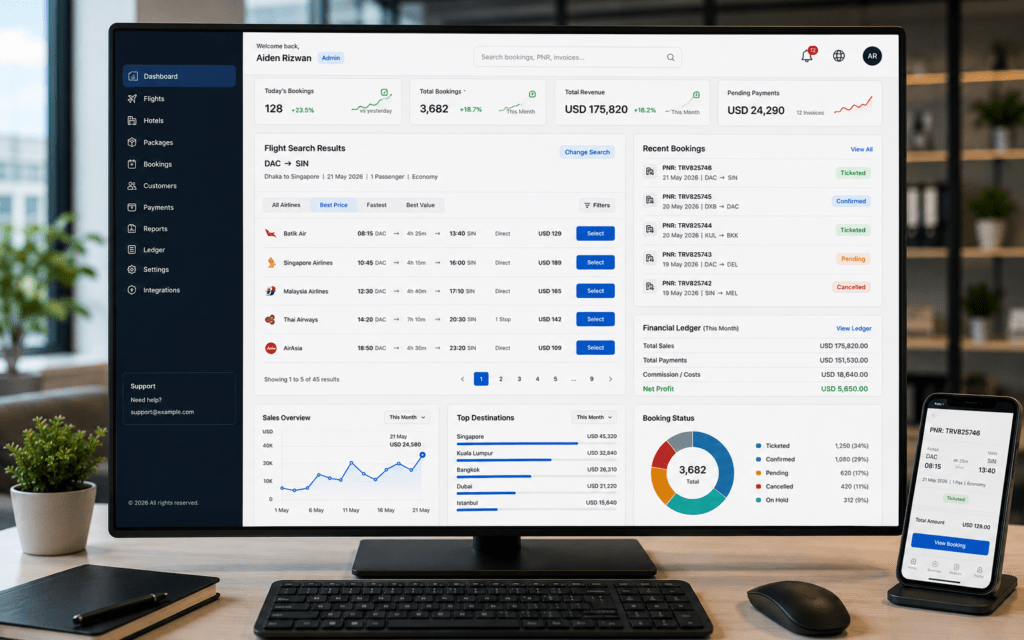
Online Travel Agency software – commonly referred to as OTA software – is a comprehensive digital platform that automates the end-to-end process of searching, booking, ticketing, and managing travel services. It replaces the fragmented ecosystem of phone calls, spreadsheets, and manual invoicing with a unified, real-time system that operates 24 hours a day.
The shift is profound. What used to take an agent forty-five minutes – searching across multiple airline portals, manually keying in passenger details, generating an invoice in a separate tool – now takes under five minutes within a properly configured OTA platform. That is not incremental improvement. That is a fundamental restructuring of how travel commerce operates.
At its core, OTA software connects travel agencies to Global Distribution Systems (GDS), airline APIs, hotel suppliers, and ancillary service providers through a single interface. It manages inventory, pricing, payments, passenger records, and reporting simultaneously. For agencies managing hundreds of bookings per week, this kind of integration is not a luxury – it is oxygen.
How OTA Software Changes the Way You Serve Customers

The customer experience transformation that follows OTA software adoption is dramatic. Travellers receive instant booking confirmations by email. E-tickets are generated automatically the moment a transaction is approved. Itinerary changes trigger notifications without any human intervention. Support teams can pull up a complete booking history in seconds.
For B2B partners – the sub-agents and corporate accounts that generate significant volume for mid-to-large agencies – the impact is even more substantial. Partners get their own portal access, their own deposit wallets, and real-time visibility into their bookings. They stop calling your front desk for status updates. They stop sending WhatsApp messages at midnight. The entire relationship becomes more professional, more scalable, and more profitable.
Must-Have Features to Look for in OTA Software for Indonesian Agencies
Real-Time Flight and Hotel Search Capabilities
The foundation of any credible OTA platform is the ability to search and display live inventory. Not cached data. Not static price lists updated once a day. Live, real-time availability pulled directly from airline systems and hotel suppliers at the moment a search is initiated.
For Indonesian agencies, this means the platform must handle the dense domestic route network – Lion Air, Garuda Indonesia, Batik Air, Citilink, and SuperAir Jet – alongside international carriers. The search interface should return results within seconds, display fare classes clearly, and flag low-availability warnings when seat counts drop below a critical threshold. Anything less is commercially unacceptable in 2025.
Multi-Currency and Local Payment Support
Indonesia operates in Indonesian Rupiah (IDR), and while international transactions occur in USD or other currencies, a robust OTA platform must handle multi-currency display and settlement without confusion. Agents should be able to quote fares in IDR, process deposits in IDR, and reconcile their ledgers in the currency they actually use day to day.
Beyond currency, payment method integration is critical. Platforms that only accept bank transfers or international credit cards are leaving a significant portion of the market unserved. Support for mobile banking gateways – SSLCommerz, Midtrans, and bank-specific APIs – is essential for agencies serving a digitally banked but card-lite clientele.
B2B and B2C Functionality in One Platform
The most commercially versatile OTA platforms serve both ends of the market simultaneously. B2C functionality allows direct consumer bookings through a clean, intuitive interface. B2B functionality provides travel agents, corporate accounts, and sub-agents with wholesale access, deposit-based wallets, and volume-based pricing.
Running both from a single platform eliminates the nightmare of managing two separate systems with two separate inventories, two separate ledgers, and two separate customer databases. Consolidation is not just operationally elegant – it is financially critical.
Automated Booking Confirmation and E-Ticket Issuance
Manual ticket issuance is a relic. In a properly configured OTA system, the moment a booking is confirmed and payment is validated, the system should automatically generate and dispatch the e-ticket to the passenger. No agent intervention required. No risk of the ticket sitting in a queue overnight while the client panics.
Automated issuance also creates an immutable record. Every ticket has a timestamp, a PNR, an airline reference, and a transaction trail. When disputes arise – and they do – this paper trail is invaluable.
Ancillary Services: Meals, Seats, Baggage, and Insurance Add-Ons
Ancillary revenue is where modern travel agencies build their margins. The base ticket fare is increasingly commoditised. But the add-ons – a preferred window seat, an extra 10 kg of checked baggage, a halal meal, travel insurance for a family of four – represent genuine value that travellers are willing to pay for.
A sophisticated OTA platform embeds ancillary selection natively within the booking flow. Not as a clunky afterthought, but as a seamless, passenger-specific selection process that updates the cart in real time and transmits the appropriate SSR codes to the airline upon confirmation. The best platforms allow ancillary purchases even post-ticketing, which means additional revenue opportunities that extend beyond the initial booking moment.
Why a Strong Booking Engine Is the Heart of Any OTA Platform
One-Way, Round Trip, and Multi-City Search: Why All Three Matter
A booking engine that only handles one-way and round-trip searches is commercially incomplete. Multi-city itineraries – Jakarta to Bali, Bali to Singapore, Singapore to Kuala Lumpur – are a staple of both leisure and corporate travel in the Indonesian market. The ability to search, price, and book complex multi-segment itineraries within a single session is a competitive differentiator that clients notice immediately.
The system must validate multi-city inputs rigorously: ensuring dates are chronologically consistent, preventing identical origin-destination pairs within the same segment, and confirming that at least one adult passenger is included. These guardrails protect both the agent and the traveller from costly booking errors.
How Smart Fare Filtering Saves Your Clients Time and Money
An unfiltered list of 40 flight options is noise. A filtered list of 6 options – sorted by cheapest, fastest, or earliest departure, with additional filters for airline preference, number of stops, and departure time window – is genuinely useful. The distinction matters enormously in a market where clients expect quick, confident answers.
Smart filtering also prevents the classic mistake of defaulting to the cheapest fare without considering the overall value. A flight that departs at 4 AM and requires a 6-hour layover in an unfamiliar city is rarely the right recommendation, even if it is technically the lowest price. Good OTA software surfaces this nuance.
The Role of GDS Integration in Indonesian OTA Platforms
What GDS Means for Your Inventory and Pricing Power
A Global Distribution System is the technological backbone through which airlines, hotels, and car rental companies distribute their inventory to travel agents worldwide. Amadeus, Sabre, and Travelport are the dominant players. Integration with one or more GDS systems gives an OTA platform access to a vast, real-time inventory pool that far exceeds what any direct airline API alone can provide.
For Indonesian agencies, GDS integration translates directly into pricing power. Access to published fares, negotiated corporate rates, and promotional inventory from hundreds of carriers simultaneously. It also means interline ticketing capabilities, codeshare flight options, and the ability to book connecting itineraries that span multiple airlines on a single PNR.
Top GDS Providers That Work Well in the Indonesian Market
Amadeus has the deepest penetration in the Indonesian market and is widely considered the industry standard for agencies handling significant international volume. Sabre is the preferred choice for agencies with strong ties to American carriers and the GDS-heavy corporate travel segment. Travelport, through its Galileo and Worldspan systems, offers competitive content for specific regional routes.
The right GDS choice depends on your agency’s mix of domestic versus international traffic, your carrier relationships, and the pricing structure your software vendor has negotiated on your behalf. A good OTA platform should ideally support multi-GDS connectivity to prevent single-point-of-failure scenarios during system outages.
Financial Management Tools That Keep Your Agency Profitable
Payment Ledgers, Deposit Requests, and Running Balances Explained
Financial clarity is the lifeblood of any travel agency. A payment ledger within an OTA platform is not merely a transaction log – it is the real-time financial conscience of your business. Every booking, every deposit, every refund, every service charge is recorded with timestamp, currency, creator identity, and order reference. The running balance updates instantaneously.
This level of transparency eliminates the end-of-month reconciliation nightmare that plagues agencies running on spreadsheets. Finance teams can see exactly how much each agent has spent, how much credit remains, and which transactions are pending approval – all from a single screen.
How Partial Payment Features Help Close More Bookings
Not every client can pay the full fare at the moment of booking confirmation. Partial payment functionality allows agencies to secure a booking with an initial deposit while recording the outstanding balance as a scheduled liability. The system tracks overdue amounts, upcoming dues, and same-day payment deadlines through a dedicated dashboard.
For agencies managing high-volume corporate accounts or group bookings, this feature is commercially essential. It prevents the binary choice between turning away a valuable client and absorbing the financial risk of an unsecured booking. The visibility it provides – Today Sales, Previous Due, Total Due, Due Today – means nothing slips through the cracks.
Managing Agent Wallets and Top-Up Systems Efficiently
A deposit-based wallet system is the cleanest way to manage B2B agent financial relationships. Agents fund their wallets in advance through bank deposit, bank transfer, cheque, or online banking. The platform records the deposit request, routes it for admin approval, applies any applicable service charges, and credits the wallet upon confirmation.
The elegance of this model is its enforceability. Agents cannot book beyond their available balance. Overbooking caused by credit limit breaches becomes structurally impossible. And because every top-up transaction is logged with a unique transaction number, the audit trail for dispute resolution is always available.
B2B Partner Management: A Feature You Cannot Afford to Skip
How Multi-Tier Agent Access Levels Protect Your Business
Not every staff member in a travel agency needs access to everything. A junior booking agent should not have visibility into the company’s full financial ledger. A branch manager in Surabaya should not be able to modify booking records created by the Jakarta head office team. Role-based access controls are not bureaucratic overhead – they are essential risk management infrastructure.
Sophisticated OTA platforms allow administrators to configure access levels with granularity: Full Access for senior agents and managers, Limited Access for booking-only staff, and Access with Data for finance team members who need reporting visibility without booking permissions. This tiered architecture reduces the risk of accidental errors, deliberate manipulation, and data breaches simultaneously.
Incentive and Reward Programs That Keep Partners Loyal
B2B partner loyalty is hard to earn and easy to lose. An incentive structure embedded directly within the OTA platform – rewarding partners based on their deposit volume, booking frequency, or geographic zone – creates a tangible reason to consolidate booking activity with your agency rather than spreading it across competitors.
The most effective incentive systems are transparent and automated. Partners can see exactly which tier they are in, what percentage bonus they are receiving on their deposits, and how long the incentive window remains valid. When the system communicates value clearly, partners respond by deepening their commitment. A 2% bonus on deposits up to IDR 20 million, scaling to 10% on volumes above IDR 200 million, is the kind of structured reward that drives measurable behavioural change.
Dashboard Analytics and Reporting: Turning Data Into Decisions
Tracking Bookings, Revenue, and Airline Performance in One Place
A well-designed OTA dashboard is more than a cosmetic feature. It is a strategic command centre. At a glance, agency managers should be able to see total bookings, total tickets issued, total sales revenue, and the top-performing airline in their portfolio – all updated in real time.
The ability to identify which carriers are generating the most revenue, which routes are seeing the highest booking velocity, and where partial payment exposure is concentrating allows managers to make proactive decisions. Renegotiate supplier terms. Reallocate marketing budget. Address cash flow pressure before it becomes a crisis. Data without context is noise. Data within a well-structured dashboard is leverage.
Daily, Weekly, Monthly, and Yearly Filters: Why Granularity Matters
Aggregate annual revenue figures are useful for board presentations. They are useless for operational management. The ability to drill down to daily booking volumes, compare this week’s performance to last week’s, or identify the specific date when a payment status shifted from Upcoming to Overdue is where dashboard granularity pays dividends.
A booking calendar view that highlights daily activity, marks selected dates, and provides a daily summary panel – showing pending, confirmed, and cancelled bookings alongside total generated revenue – gives operations teams the precise situational awareness they need to act quickly when anomalies arise.
Top Online Travel Agency Software Options Available in Indonesia
Cloud-Based vs On-Premise: Which One Suits Indonesian Agencies Better
Cloud-based OTA platforms have become the dominant choice for agencies of all sizes, and for good reason. They eliminate the capital expenditure of server infrastructure, reduce IT maintenance overhead, and enable real-time access from any device with an internet connection. In a country where agents are frequently mobile and branch offices are geographically dispersed, cloud access is not a nice-to-have – it is a practical necessity.
On-premise solutions retain appeal for large enterprises with specific data sovereignty requirements or agencies operating in regions with unreliable internet connectivity. But for the vast majority of Indonesian travel agencies – from boutique operators to mid-market B2B specialists – a cloud-first platform offers the best balance of cost, flexibility, and scalability.
Homegrown Indonesian Solutions vs International Platforms
There is a genuine tension in the market between internationally developed OTA platforms with global feature sets and locally built solutions that understand the Indonesian market intricately. International platforms bring deep GDS integration, multinational support, and proven scalability. But they often require significant localisation work, charge in foreign currency, and provide support across time zones that do not align with Indonesian business hours.
Homegrown platforms – particularly those built by technology companies deeply embedded in the Indonesian B2B travel ecosystem – offer native IDR pricing, local payment gateway integration, Bahasa Indonesia support, and customer service teams that understand the specific regulatory and operational context of doing business in Indonesia. The ideal evaluation process weighs both options honestly against your agency’s specific priorities.
How to Evaluate OTA Software Before You Commit
Questions to Ask Any Software Vendor Before Signing a Contract
Vendor conversations are negotiations, not presentations. Come prepared. Ask whether the platform supports all three trip types – one-way, round trip, and multi-city. Ask how ancillary services are handled and whether they can be added post-ticketing. Ask which GDS providers are integrated and whether multi-GDS connectivity is available. Ask how wallet top-ups are processed and approved. Ask about the SLA for technical support resolution times.
Ask specifically about what happens when a PNR issuance fails. Does the system prevent ancillary charges from being recorded? Is revenue generation atomic with ticketing? These are not esoteric technical questions – they are the difference between a trustworthy platform and a financial liability.
Red Flags to Watch Out for During a Demo
A demo that shows only the prettiest screens without demonstrating the financial reconciliation workflow is incomplete. Vendors who cannot clearly explain their GDS integration architecture, cannot show you a live payment ledger with running balances, or become evasive when asked about data export capabilities should be approached with significant caution.
Watch for platforms that lack role-based access controls, have no visible audit trail on booking modifications, or cannot demonstrate partial payment tracking. These gaps do not announce themselves as risks during a sales presentation. They announce themselves as crises six months after you have migrated your entire client database to the system.
Free Trials and Pilot Programs: Making the Most of Them
A trial period is not a passive experience. Treat it as a structured audit. Assign your most technically capable agent to run live bookings through the system – including a multi-city itinerary, an ancillary selection, a deposit request, and a booking cancellation – and document every friction point. Measure how long each workflow takes compared to your current process.
Involve your finance team in reviewing the payment ledger and deposit approval workflow. Involve your IT team in assessing integration capabilities and data security measures. A trial that only scratches the surface of core features will not reveal the operational realities that emerge under production-level usage.
Customer Support and After-Sales Service: The Overlooked Dealbreaker
Why Local Language Support Matters More Than You Think
Technical support documentation written entirely in English is a barrier. Support ticketing systems that operate only during US or European business hours are a barrier. For an Indonesian travel agency fielding client calls at 9 PM Jakarta time when a booking has gone wrong, the ability to reach a responsive, Bahasa Indonesia-capable support team is not a secondary consideration – it is critical infrastructure.
Language is not just about convenience. It is about the speed and precision with which problems get resolved. When a support agent and a travel agent share both language and cultural context, issue diagnosis happens faster, solutions are communicated more clearly, and client confidence is restored more quickly.
What Good Technical Support Looks Like in Practice
Good technical support is proactive, not merely reactive. It means a vendor who monitors your system health and flags anomalies before you notice them. It means a dedicated account manager who understands your agency’s specific configuration and can provide contextual guidance rather than generic FAQ responses.
It also means clearly documented escalation paths. When a GDS connection drops during peak booking hours, who do you call? What is the guaranteed response time? What compensation mechanism exists for downtime-related revenue loss? These are uncomfortable questions to ask in a sales meeting. They are essential questions to have answered before you sign.
Security, Compliance, and Data Protection for Indonesian Travel Agencies
PCI DSS Compliance and Secure Payment Gateways
Any OTA platform that processes payment card data must comply with the Payment Card Industry Data Security Standard. PCI DSS compliance is not a marketing badge – it is a rigorous technical and operational framework that dictates how cardholder data is stored, transmitted, and protected. Non-compliant platforms expose your agency to financial penalties, reputational damage, and potential loss of the ability to process card payments.
Beyond PCI DSS, Indonesian agencies should verify that their software vendor complies with Bank Indonesia’s electronic transaction regulations and any applicable provisions of Indonesia’s Personal Data Protection Law (UU PDP), which came into force in 2024. Ignorance of regulatory obligations is not a defence when something goes wrong.
Keeping Customer Passport and Personal Data Safe
Travel bookings are extraordinarily data-rich. Passport numbers, dates of birth, nationalities, contact details, travel histories – all of it is sensitive personal information that attracts malicious actors. An OTA platform must enforce encryption at rest and in transit, implement strict access controls that prevent unauthorised data retrieval, and provide audit logs that record every instance of sensitive data access.
Passengers upload passport scans. Agents store payment references. Finance teams record bank account details. Every layer of this data ecosystem must be protected. Ask your vendor specifically about their data retention policy, their breach notification protocol, and whether your data is stored on Indonesian servers or offshore infrastructure – a question with both practical and regulatory implications.
Scalability: Choosing Software That Grows With Your Agency
Starting Small but Planning Big: What to Look for in a Scalable System
The software that serves a five-person agency in Yogyakarta should ideally be the same software that can accommodate a fifty-person operation with multiple branches, a B2B partner network, and thousands of monthly bookings. Not every agency starts large. But every ambitious agency plans to grow.
Scalable OTA software is architected to accommodate increasing transaction volumes without degrading performance. It supports the addition of new users, new branches, and new supplier integrations without requiring system re-implementation. Pricing models should scale predictably – whether per transaction, per user, or per booking volume tier – so that growth does not create sudden, destabilising cost jumps.
Multi-Branch and Multi-Staff Features for Expanding Agencies
As agencies expand geographically, the ability to manage multiple branch locations within a single platform becomes invaluable. Each branch should have its own contact details, time zone configuration, and staff roster while sharing the same booking engine, inventory, and financial infrastructure. Branch managers should be able to see activity at their location without accessing data from other branches.
Staff management within an OTA platform should allow administrators to assign roles, set access levels, link staff members to specific branches, and monitor activity with a timestamped creation record. This level of organisational architecture transforms the platform from a booking tool into an operational management system – one that scales elegantly as the business evolves.
How to Successfully Migrate From Legacy Systems to Modern OTA Software
Common Migration Mistakes and How to Avoid Them
The most common migration failure mode is attempting to do too much too quickly. Agencies that try to migrate their entire booking history, all their B2B partner accounts, and their complete financial records simultaneously – while also training staff and running live bookings – almost always encounter chaos. A phased migration strategy, beginning with new bookings while legacy data is migrated in parallel, dramatically reduces operational risk.
Data quality is another common stumbling block. Legacy systems frequently contain duplicate passenger records, inconsistent PNR formats, and incomplete transaction histories. Cleaning this data before migration – rather than importing the mess and hoping the new system can sort it out – saves enormous pain downstream.
The third mistake is underestimating the IT resources required. Even a cloud-based platform requires configuration work: payment gateway integration, GDS connectivity testing, user account setup, and role assignment. Build a realistic implementation timeline and hold your vendor accountable to it contractually.
Staff Training Tips to Speed Up Adoption
Technology adoption fails when training is treated as a one-time event rather than an ongoing process. A single two-hour walkthrough on launch day is insufficient. Staff need hands-on practice under supervised conditions, access to reference documentation in their own language, and a clear escalation path for questions that arise during live usage.
Identify internal champions early – agents who are naturally curious about technology and willing to invest time in mastering the new system. These individuals become peer trainers, reducing the burden on vendor support teams and building internal institutional knowledge. Celebrate early wins publicly: the first ticket issued in under three minutes, the first ancillary upsell completed without assistance. Positive reinforcement accelerates adoption far more effectively than mandatory compliance.
Real Results: What Indonesian Travel Agencies Gain After Going Digital
Faster Booking Times, Fewer Errors, Happier Clients
The operational improvements that follow OTA software adoption are measurable and rapid. Booking processing times drop from forty-five minutes to under five. Ticketing errors caused by manual data entry fall toward zero. Client satisfaction scores improve because travellers receive instant confirmations instead of waiting hours for a callback.
For agencies managing high-volume corporate accounts, the time savings compound dramatically. An agent who previously spent six hours per day processing manual bookings can now handle the same volume in ninety minutes – freeing the remainder of their time for client relationship management, upselling, and business development activities that actually grow revenue.
Revenue Growth Through Upselling Ancillary Services
The revenue impact of ancillary integration is consistently underestimated. Agencies that actively present seat, meal, baggage, and insurance options within the booking flow report meaningful increases in per-booking revenue. The key word is “within” – ancillary options presented after ticket issuance convert at significantly lower rates than those presented during the active booking session.
When a client is already engaged, already committed to travelling, and already in the process of entering passenger details, the cognitive barrier to adding a preferred seat or a 20 kg baggage allowance is minimal. The incremental revenue per booking is modest. Across thousands of bookings per month, it is transformative.
Making Your Final Decision: A Quick Checklist Before You Buy
Before committing to any OTA platform, run through this checklist:
- Does the platform support one-way, round-trip, and multi-city bookings natively?
- Is ancillary selection embedded within the booking flow, not bolted on afterwards?
- Does it offer multi-currency support and local Indonesian payment gateway integration?
- Is there a B2B partner portal with deposit wallet and incentive management?
- Does the payment ledger provide real-time running balances with full audit trails?
- Are role-based access controls granular enough to match your organisational structure?
- Is the platform PCI DSS compliant and aligned with Indonesian data protection law?
- Does the vendor offer local language support during Indonesian business hours?
- Is the platform cloud-based with a transparent, scalable pricing model?
- Does the vendor provide a meaningful free trial or pilot programme?
- Can the system generate automated e-tickets without manual agent intervention?
- Does the dashboard support time-filtered analytics at daily, weekly, monthly, and yearly granularity?
If any answer is “no” or “we will need to check,” treat it as a critical gap requiring resolution before signature.
The Future of OTA Software in Indonesia: What’s Coming Next
AI, Mobile Apps, and Personalization: The Next Wave of Travel Tech
The next generation of OTA platforms will not merely automate existing workflows – they will anticipate them. Artificial intelligence is beginning to reshape fare prediction, personalised itinerary recommendation, and dynamic pricing optimisation. Agencies that adopt AI-augmented platforms will be able to offer clients genuinely personalised travel recommendations based on booking history, preference patterns, and real-time pricing signals.
Mobile app deployment – currently Phase 2 for many platforms – will bring the full booking engine to smartphones, enabling agents to process transactions from anywhere. For Indonesia, where mobile internet penetration significantly exceeds desktop, this transition is not incremental. It is a fundamental shift in where and how travel commerce happens.
Personalization at scale – presenting the right fare, to the right traveller, at the right moment, with the right ancillary bundle – is the competitive frontier. Agencies that invest in platforms architected for this future will be positioned to lead. Those still managing bookings manually in 2027 will be competing for a rapidly shrinking share of a market that has moved on without them.
Conclusion: The Right Software Is the Foundation of Everything
The Indonesian travel market is abundant with opportunity. But opportunity without operational infrastructure is just potential. The agencies that will define the next decade of travel in Indonesia are not necessarily the largest or the best-funded. They are the ones that have made the strategic decision to build their businesses on software that actually works.
The right OTA platform does not just automate bookings. It manages your finances, empowers your B2B partners, protects your data, scales with your ambition, and gives you the analytical visibility to make better decisions every single day.
Ready to Grow Your Travel Agency? Here’s How Travilo Can Help
Travilo, is a comprehensive B2B-first Online Travel Agency platform built specifically for the operational realities of the South and Southeast Asian travel market – including Indonesia.
Here is what Travilo brings to your agency from day one:
Powerful Booking Engine – Search and book one-way, round-trip, and multi-city flights with real-time availability, smart fare filtering, and a countdown-protected hold mechanism that prevents fare loss during passenger data entry.
Native Ancillary Management – Meal, seat, baggage, and insurance selection embedded directly within the booking flow, accessible at pre-booking, post-booking, and post-ticketing stages. Every ancillary selection is passenger-specific, segment-specific, and cart-updated in real time.
B2B Partner Portal – Sub-agents and corporate partners get their own login, deposit wallet, booking history, and incentive dashboard. Role-based access controls – Full Access, Limited Access, Access with Data – protect your business from internal risk.
Complete Financial Infrastructure – A real-time payment ledger, deposit request management, partial payment tracking with Today Sales / Previous Due / Total Due / Due Today visibility, and multiple deposit methods including bank deposit, bank transfer, cheque, and online banking via major gateways.
Incentive System – Structured, admin-configurable reward programs that increase B2B partner wallet deposits and booking volume through transparent, zone-based percentage incentives.
Centralised Dashboard – Booking management, airline performance analytics, partial payment monitoring, and a booking calendar with daily revenue summaries – all filterable by Daily, Weekly, Monthly, and Yearly periods.
Company Settings and Branch Management – Multi-branch architecture, staff management with access level control, bank account management, and document storage for a fully organised operational backbone.
Built-In Support Ticketing – Agents can raise support tickets linked directly to Tracking ID, PNR, or ticket number, ensuring that every issue has context, categorisation, and a tracked resolution timeline.
If your agency is ready to move from operational chaos to operational clarity – if you are ready to issue tickets faster, manage partners more professionally, and grow your revenue through systematic ancillary upselling – Travilo is built for exactly that journey.
Visit travilo.io to explore the platform, or contact the Travilo team to arrange a personalised demonstration tailored to your agency’s specific needs.
Your next chapter in travel starts with the right foundation. Make it Travilo.